Cold Plunge
Cold Plunge Temperature: The Complete Guide
Learn the ideal cold plunge temperature ranges for beginners through advanced users, with a science-backed progression guide and safety thresholds explained.
Disclosure We may earn a commission from links on this page, at no extra cost to you — and we only recommend gear we'd stand behind. How this works.
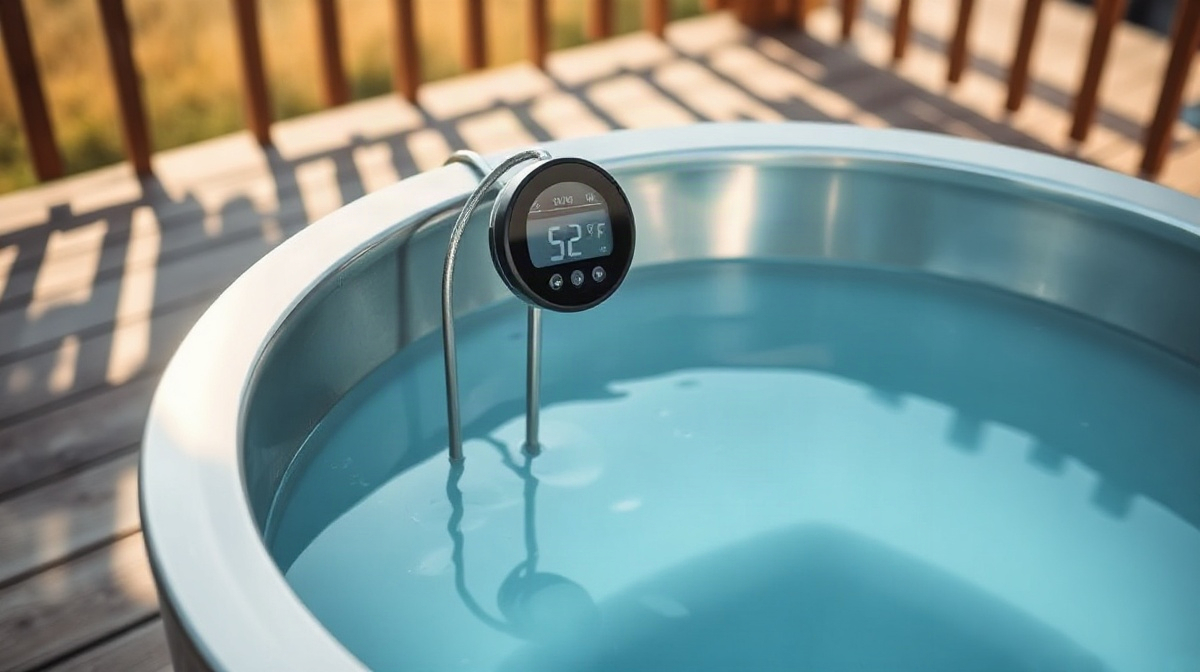
BALDR Pool Thermometer Floating Easy Read, Solar Pool Thermometer with Digital Display, IPX8 Waterproof for Hot Tubs, Cold Plunge & Swimming Pools (Dark Blue)
Best for Cold plunge tubs — digital display, solar-powered, IPX8 waterproof
The most purpose-built option on this list for cold plunge monitoring. If you only buy one thermometer for a dedicated cold plunge tub, this is it.
The good
- Digital display is easy to read at a distance
- Solar-powered — no battery changes
- IPX8 waterproof rating, explicitly designed for cold plunge use
- Floats stably in tub
The catch
- No wireless remote display
- Solar charging inconsistent in overcast or indoor conditions — display can dim unexpectedly
HATUSOKU Digital Thermometer with External Sensor, Magnet, Suction Cup, Water Thermometer, Aquarium, Refrigerator, Freezer (Black)
Best for Wall-mounted digital probe accuracy at minimal cost
Best digital value. The probe-and-display design is genuinely more accurate than floating analog units at less than half the price of the BALDR.
The good
- 4.4 stars across ~2,700 reviews — unusually strong for sub-$10
- External probe sensor for precise water readings
- Magnet and suction cup mounting options
- Fast temperature response
The catch
- Display unit not fully weatherproof — keep it sheltered
- Probe cable is short enough to limit placement on deeper tubs
TempPro TempAir Wireless Pool Thermometer Floating Easy Read with Batteries
Best for Checking water temperature remotely before getting in
Worth the premium if you want to confirm temperature before leaving the warm house. Not necessary for everyone, but genuinely convenient in cold climates.
The good
- Wireless display — check temp from indoors
- Best Seller with 2,100+ reviews
- Includes batteries
- Easy setup per owner reports
The catch
- Most expensive option here
- 4.1 stars is the lowest rating in this group
- Wireless connection drops through more than one wall in some homes
Floating Pool Thermometer, Large Display with String Easy to Read, Shatter Resistant, for Outdoor & Indoor Swimming Pools, Spas, Hot Tubs & Aquariums (Turtle)
Best for Budget-friendly analog backup or beginner starter thermometer
At under $7, it's the easiest recommendation for anyone who just wants a reliable analog check. A solid backup for any plunge setup.
The good
- Amazon's Choice — strong validation at this price
- 4.4 stars from 1,900 reviews
- Shatter resistant
- No batteries or setup required
The catch
- Analog only — less precise than digital
- Scale markings are small; some reviewers note difficulty reading mid-plunge without glasses
The single most important variable in cold plunge practice isn’t duration, breathing technique, or time of day. It’s temperature — and the number is almost always wrong. Some people start at 39°F and flame out in a week; others idle at 62°F and wonder why they’re not feeling much.
Research in sports medicine consistently points to 50–59°F (10–15°C) as the core functional range. Drop below that and you’re in territory that demands real cold adaptation and genuine risk awareness. Climb above 60°F and you start blunting the acute stress response behind most of the documented benefits. What follows breaks that down by goal, experience level, and physiology.
What does the research say is the ideal cold plunge temperature?
Several studies on cold water immersion (CWI) in athletic recovery contexts have used the 50–59°F (10–15°C) range as their target protocol. A 2012 meta-analysis by Leeder et al. in the British Journal of Sports Medicine examined CWI for muscle soreness and found that this temperature band produced measurable effects on delayed-onset soreness and perceived recovery. A paper published in the Journal of Physiology on CWI and cardiovascular response noted that water at or below roughly 59°F (15°C) is generally required to produce the strong physiological responses associated with cold immersion.
Below roughly 50°F (10°C), the physiological intensity increases substantially. Above 60°F (15.5°C), the cold stimulus weakens — though it may still be appropriate for certain populations or early-stage beginners.
One important caveat: most published studies used controlled lab protocols, not consumer cold plunge tubs. Your equipment, ambient air temperature, and how long you’ve been in the water all affect what temperature the water actually is when your body is in it. The gap between lab conditions and a backyard barrel matters more than most guides acknowledge.
Beginner to Advanced: A Temperature Progression Guide
Beginner — 60°F to 55°F (15.5°C to 12.8°C)
Start here. The cold shock response — involuntary gasping, elevated heart rate, the urge to exit immediately — is real and can be disorienting. The 55–60°F range lets your nervous system adapt without the full physiological load of colder water.
Practitioners widely recommend starting at the warmer end of this range and dropping 2–3 degrees at a time to build tolerance, rather than beginning at 50°F. The goal at this stage is consistent, repeatable exposure — not suffering. Duration: 2–4 minutes.
Intermediate — 55°F to 50°F (12.8°C to 10°C)
This is where most regular cold plungers settle. The 50–59°F range is the most studied, the most frequently recommended by sports medicine practitioners, and where the research-to-real-world overlap is strongest. Søberg et al.’s 2021 paper in Cell Reports Medicine — which studied cold water immersion protocols — documented substantially elevated norepinephrine and dopamine levels in young male winter swimmers following cold exposure. Those figures are specific to that study’s subjects and protocols, not a universal benchmark, and should not be taken as a guaranteed individual outcome.
Duration here typically runs 5–10 minutes. Most practitioners advise stopping at the first sign of uncontrollable shivering — not because mild shivering is dangerous, but because it signals you’ve absorbed a significant cold stimulus and further time yields sharply diminishing returns.
Advanced — 50°F to 45°F (10°C to 7.2°C)
Below 50°F, you need real experience and genuine respect for what the cold can do. Cold shock, cardiovascular stress, and peripheral vasoconstriction all intensify. Research on elite athletes using post-exercise CWI protocols sometimes uses temperatures in this range — typically for shorter durations (3–6 minutes) and always with prior cold adaptation.
This range is not appropriate for beginners, people with cardiovascular conditions, or anyone plunging alone.
Extreme — Below 45°F (below 7.2°C)
Some purpose-built cold plunge chillers can push water to 39–40°F (3.9–4.4°C). Even experienced plungers typically limit exposure to 2–4 minutes at these temperatures. Hypothermia risk is real. Added benefit over the 45–50°F range is not clearly established in published literature — so this is intensity for intensity’s sake, not documented optimization. Unless you’re a cold water swimming competitor working with a trained coach, there is no well-established reason in the published research to go below 45°F for general health or recovery purposes.
How does temperature interact with duration?
These two variables work together. Colder water means less time needed for an equivalent stimulus. The following windows represent editorial judgment synthesizing practitioner frameworks and the temperature ranges used in sports medicine CWI literature (primarily Leeder et al. 2012 and Søberg et al. 2021) — they are guidelines, not clinical mandates:
- 60°F / 15.5°C → 10–15 minutes for a stimulus worth having
- 55°F / 12.8°C → 8–10 minutes
- 50°F / 10°C → 5–8 minutes
- 45°F / 7.2°C → 3–5 minutes
- 39–40°F / ~4°C → 2–3 minutes (advanced only)
Søberg et al. (2021) is among the research underlying the commonly referenced target of roughly 11 minutes of total cold immersion per week, distributed across multiple sessions. That study doesn’t prescribe an exact temperature, but the protocols used fell in the cold immersion range consistent with 50–59°F zone practices. The practical framing you’ll hear from experienced practitioners: cold enough that you want out, not so cold that you’re fighting your body into a crisis.
Does temperature need to be different for women?
The honest answer: possibly, but the research isn’t there yet to be specific.
The physiological rationale is plausible — women tend to lose core body temperature faster than men of similar size, due to average differences in muscle mass and subcutaneous fat distribution, as documented in thermoregulation research broadly. However, sex-specific CWI temperature protocols have not been formally validated in large clinical trials. Some practitioners recommend that women — especially smaller-framed — start 2–3°F warmer than general guidelines and monitor closely. That’s reasonable given the physiology. A precise, sex-specific temperature prescription isn’t supported by current evidence, and anyone telling you otherwise is running ahead of the data. Monitor your own response and adjust accordingly.
Safety thresholds you should not ignore
Cold water immersion carries real physiological risks. Nothing in this guide constitutes medical advice — consult a physician before beginning cold water immersion, particularly if you have any underlying health conditions.
Cold shock response occurs in the first 30–90 seconds and is the most dangerous phase for people with undiagnosed cardiovascular conditions. Gasping, hyperventilation, and sudden heart rate spikes happen here — fast, and without warning.
Hypothermia risk climbs sharply below 50°F when sessions exceed 10 minutes, particularly in people with low body fat or those who are fatigued. Sensory feedback — the physical signals you’d normally rely on as a warning — can diminish faster than expected in very cold water.
Never plunge alone in very cold water, especially below 50°F. Loss of consciousness in cold water is documented in the medical literature, and it can occur without prior warning signs.
Anyone with heart disease, hypertension, Raynaud’s syndrome, or who is pregnant should consult a physician before starting cold water immersion. Research suggests potential benefits for some populations; it does not guarantee individual safety.
How to actually track your cold plunge temperature
A floating analog thermometer is the floor — the bare minimum. A digital probe thermometer with a remote display is more accurate and easier to read from outside the tub. Neither is complicated to use. But eyeballing whether your water “feels about 52°F” isn’t measurement — if you miscalibrate by even 5°F you could be running a beginner protocol at advanced-range temperatures without knowing it. Here are the best options across price points.
The thermometers worth using
BALDR Solar Pool Thermometer — Best for Cold Plunge Tubs
The BALDR (ASIN B0CSFGD67D) is the most purpose-built digital thermometer on this list for cold plunge use. Rated IPX8 waterproof, solar-powered (no battery-swap frustration), and explicitly marketed for cold plunge tubs. The digital readout is visible from a distance — reviewers consistently call this out as the unit’s main practical advantage. The dark blue colorway makes it easy to spot in a tub. If you’re buying one thermometer for a dedicated plunge setup, this is the one.
One genuine gripe that turns up in reviews: in overcast climates or indoor setups, the solar charging can be inconsistent, and a few buyers report the display dimming unexpectedly after cloudy stretches.
Not for: Anyone who wants a wireless display they can monitor from indoors before stepping outside.
HATUSOKU Digital Thermometer (Black or White) — Best Digital Probe Value
The HATUSOKU (Black: B0B7LRM2KQ, White: B09QW4LK6H) uses an external probe sensor and attaches via magnet or suction cup — practical for plunge tub walls. At under $10, 4.4 stars across roughly 2,700 reviews is a legitimately strong result. One recurring complaint in the review pool: the probe cable is short enough that placement options are genuinely limited on deeper tubs, forcing the display unit closer to the waterline than some users want. The probe-and-display design is still more accurate than most floating analog units.
Not for: Outdoor use in rain without shelter. The display unit itself isn’t fully weatherproof, which matters if your setup is exposed.
TempPro TempAir Wireless Pool Thermometer — Best for Remote Monitoring
The TempPro (B0F82YHBYQ) is the priciest option here and the most convenient. A wireless display means you can confirm water temperature before you leave the warm house — which, in a cold climate, is not a trivial feature. Best Seller status with 2,100+ reviews and a 4.1-star rating. That 4.1-star average is the lowest in this group, and it’s not random noise: a recurring thread in critical reviews flags that the wireless connection drops when the receiver is separated from the transmitter by more than one wall, which limits indoor monitoring setups in larger homes.
Not for: Minimalists, or anyone whose plunge tub is close enough to glance at easily.
Turtle Floating Pool Thermometer — Best Budget Option
$6.99 as of October 2026. Amazon’s Choice. 4.4 stars from 1,900 reviews. Analog, shatter-resistant, no batteries, no app, nothing to configure. It floats, you read it. For a backup thermometer or a starter option for someone new to cold plunging, that’s about all you need it to do — and it does it reliably. The one complaint worth knowing: the scale markings are small, and a few reviewers mention needing readers to check it mid-plunge.
Not for: Anyone who wants digital precision or needs to check temperature from outside the tub.
Frequently asked questions
What is the ideal cold plunge temperature for beginners?
55–60°F (12.8–15.5°C) is the recommended starting range. This is cold enough to trigger a real stress response but forgiving enough to let your nervous system adapt. Most practitioners suggest dropping 2–3°F per week as tolerance builds.
How cold is too cold for a cold plunge?
Water below 45°F (7.2°C) carries significant hypothermia and cold shock risk, especially for sessions longer than 3–4 minutes. There is no well-established evidence that going below 45°F adds benefit over the 50–55°F range for general health or recovery purposes. Below 40°F is considered extreme and should only be attempted by experienced, supervised practitioners.
Is 60°F cold enough to cold plunge?
60°F (15.5°C) sits at the upper boundary of the documented effective range. Research generally suggests water needs to be at or below 59°F (15°C) to produce the strongest physiological responses studied in the literature. At 60°F, beginners will still feel a strong cold stimulus, but experienced plungers may find it underwhelming.
How long should you stay in a cold plunge at 50°F?
Most practitioners and synthesized protocols drawing on published CWI research suggest 5–8 minutes at 50°F (10°C) is effective. Stop at the first onset of uncontrollable shivering. A total weekly cold exposure of roughly 11 minutes across multiple sessions is a commonly referenced target in practitioner literature, informed in part by Søberg et al. (2021).
Does cold plunge temperature need to be different for women?
Emerging research suggests women may lose core body temperature faster during cold water immersion due to average differences in muscle mass and body composition. Some practitioners recommend women start 2–3°F warmer than general guidelines and reduce session duration relative to men of similar experience. This area of research is still developing, so individual monitoring matters more than a fixed rule.
Sources
- Cold-water immersion (cryotherapy) after exercise: a systematic review of the literature — Leeder et al. (2012) — British Journal of Sports Medicine
- Søberg et al. (2021) — Altered brown fat thermoregulation and enhanced cold-induced thermogenesis in young, healthy, winter-swimming men — Cell Reports Medicine
- Cold Water Immersion: Kill or Cure? — Journal of Physiology — The Journal of Physiology
- Forbes Health: Cold Plunges — Health Benefits, Risks And More — Forbes Health
- BALDR Pool Thermometer product listing — Amazon — Amazon
- HATUSOKU Digital Thermometer product listing — Amazon — Amazon
- TempPro TempAir Wireless Pool Thermometer — Amazon — Amazon
- Turtle Floating Pool Thermometer — Amazon — Amazon