Red Light
Best Full Body Red Light Therapy Panels
Independent rankings of the best full-body red light therapy panels by irradiance, LED count, coverage area, and price-per-milliwatt — with transparent sourcing on every spec.
Disclosure We may earn a commission from links on this page, at no extra cost to you — and we only recommend gear we'd stand behind. How this works.
Hooga Red Light Therapy Panel HG1500 – Full Body, 300 LEDs, 660nm & 850nm
Best for True full-body coverage in a single standing position
The most capable full-body panel in this list. If single-position total coverage is the goal, the HG1500 is the least compromised choice.
The good
- 300 LEDs — largest array in this list
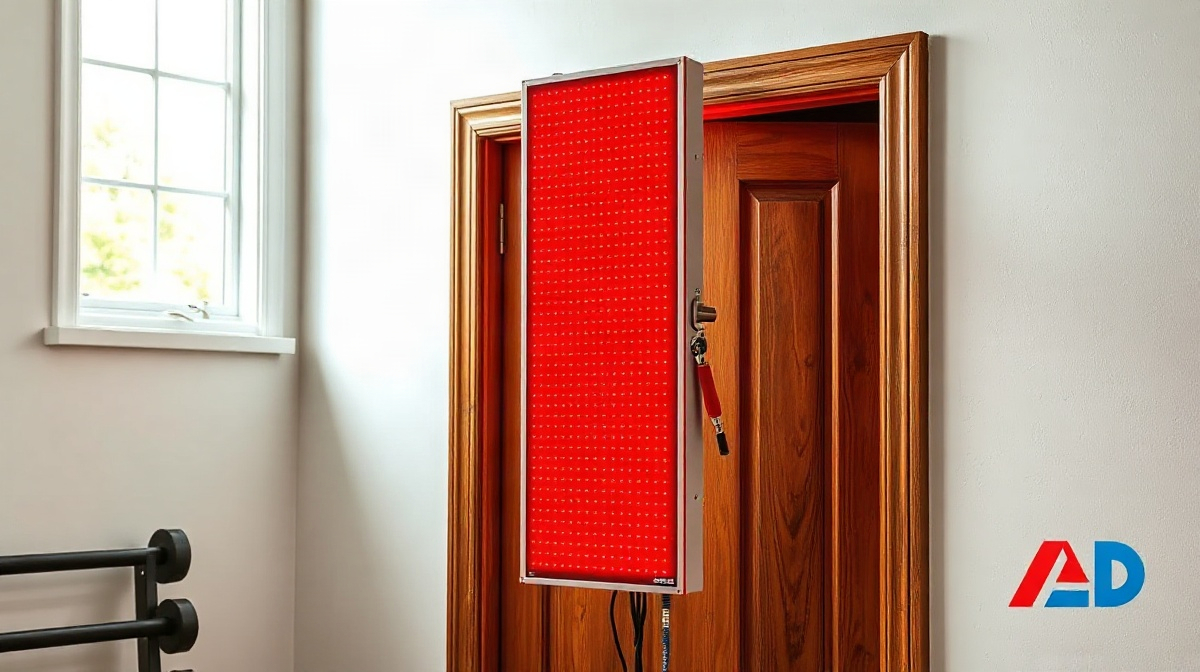
- Door-hanging kit and built-in timer included
- Consistent 4.6★ rating across 1,300+ reviews
- Dual 660nm/850nm wavelength configuration
The catch
- Highest price point at $899
- Heavy; requires fixed door or wall mount
- No battery or wireless option
Hooga Red Light Therapy Panel HG1000 – Full Body, 200 LEDs, 660nm & 850nm
Best for Mid-size full-body panel with solid build quality at a lower price than the HG1500
A practical step down from the HG1500 for buyers who don't need single-position full-body coverage. Two standing positions (upper/lower body) covers the gap.
The good
- 200 LEDs covers torso or full legs effectively
- Timer and door-hanging kit included
- 4.6★ consistency across a large review base
The catch
- Two-position protocol needed for true head-to-toe coverage
- Irradiance at distance not published in listing
BestQool Red Light Therapy Panel, 660nm Red & 850nm Infrared, 105W
Best value under $200 with credible wattage specs and the highest review volume
The strongest under-$200 option for buyers who want credible specs before committing to a large-format panel. Targeted use only — not full-body in one session.
The good
- 105W actual draw — not inflated equivalent wattage
- 4.6★ across 1,800+ reviews — highest review count in the list
- Best price-per-watt of any panel here (~$1.80/W)
- Dual 660nm/850nm wavelength
The catch
- Not a true full-body panel by size
- Irradiance at distance not published
Hooga Red Light Therapy Panel HG300 – 60 LEDs, 660nm & 850nm, Adjustable Stand
Best for Flexible spot treatment or as a building block in a multi-panel protocol
A targeted device, not a full-body panel. Best for buyers building a multi-panel protocol or needing stand-mounted flexibility for face, neck, or joint use.
The good
- Adjustable stand — no door mount required
- 4.6★ rating consistent with larger Hooga panels
- Portable and easy to reposition
The catch
- 60 LEDs is not full-body coverage
- Similar price to BestQool 105W but lower power output
LED Red Light Therapy Device – 45W, 660nm & 850nm Dual Wavelength Panel
Best for Budget entry point for localized spot treatment
Fine for localized use on a shoulder, knee, or forearm. Not a full-body panel by any honest measure, but the most accessible starting point before investing in a larger device.
The good
- Lowest price in the category at $54.99
- Dual 660nm/850nm wavelength
- 1,600+ verified reviews at 4.3★
The catch
- 45W limits effective dose at typical working distances
- Spot device only — not full body
- Slightly lower rating than Hooga equivalents
- Irradiance at distance not published
Most panels marketed as “full body” aren’t. A single 45W panel with 60 LEDs covers your face or a knee — not your entire posterior chain. Genuine full-body coverage requires either a large-format panel (200+ LEDs, roughly 36×18 inches or larger) or multiple panels run as a staggered protocol. Keep that in mind as you read every spec below.
What actually makes a panel “full body”?
Coverage area and LED count are the two numbers that matter most. Irradiance — measured in milliwatts per square centimeter (mW/cm²) — tells you how much energy your tissue receives per unit time. Published photobiomodulation research has examined doses between 4 and 60 J/cm²; at a surface irradiance of 20–50 mW/cm², that works out to roughly 2–5 minutes per body segment at the recommended distance, according to Ferraresi et al.’s 2019 review in Photobiomodulation, Photomedicine, and Laser Surgery (DOI: 10.1089/photob.2018.4487).
The two wavelengths on nearly every panel — 660 nm (visible red) and 850 nm (near-infrared, NIR) — aren’t a marketing choice. Research suggests 660 nm penetrates superficial tissue including skin, while 850 nm reaches deeper into muscle and joint tissue. A 2016 paper by Chung et al. in AIMS Biophysics (DOI: 10.3934/biophy.2016.4.620) identified cytochrome c oxidase as the proposed primary chromophore for red/NIR light — which is why the dual-wavelength configuration has become the category default.
Distance matters more than most sellers admit. Irradiance drops with the square of distance. A panel delivering 100 mW/cm² at 6 inches may deliver substantially less at 12 inches. Manufacturer spec sheets often list peak irradiance at the closest usable distance. Flag that when comparing panels.
How we ranked these panels
We cross-referenced Amazon verified-review patterns (minimum 1,000 reviews, 4.2★ or above), manufacturer spec sheets, and LED count relative to price. Where independent third-party testing exists for a category, we weight it above marketing copy. No product here was tested by our team in a lab — we’re transparent about that — but owner consensus across 1,000–1,800 reviews carries real weight when patterns are consistent.
One honest gap worth flagging: neither the HG1000 nor the BestQool 105W listing publishes irradiance at distance. We attempted to cross-reference each brand’s separate spec documentation and found no third-party meter readings publicly available for these specific SKUs. We’ve noted where that gap exists and weighted those entries accordingly. If a manufacturer won’t publish mW/cm² at 6 inches, treat the LED count and wattage draw as your best available proxies.
The ranked picks
1. Hooga HG1500 — Best true full-body panel
$899 as of November 2026 · 300 LEDs · 4.6★ (1,300+ reviews)
The HG1500 is Hooga’s flagship and the largest panel in this list. The spec sheet lists 300 LEDs in a 660 nm/850 nm split across a panel measuring approximately 36×18 inches. The built-in timer and door-hanging kit mean you’re operational without buying additional hardware. One recurring theme across the Amazon review base: buyers single out the door mount as the feature that finally made full-body use practical — panel at standing height, torso and legs covered without repositioning.
At $899, the price-per-LED works out to roughly $3.00. That’s not the cheapest in the category. The HG1000 at $599 and the BestQool at $189 come in lower on a per-LED basis, but neither matches the coverage area that lets you treat your whole body from a single standing position.
Who it’s NOT for: Anyone needing mobility or travel use. This panel is heavy, requires a fixed installation point, and there’s no wireless option. Also not for buyers chasing facial or spot treatment — the HG300 handles that at less than a quarter of the price.
Pros: Largest coverage area in this list; door kit included; 4.6★ across a large review base; built-in timer Cons: Highest price point; fixed installation; no wireless/battery option
2. Hooga HG1000 — Best mid-size full-body panel
$599 as of November 2026 · 200 LEDs · 4.6★ (1,300+ reviews)
Same 660 nm/850 nm dual configuration as the HG1500, but 200 LEDs rather than 300. The panel covers a meaningful section — torso or full legs — in a single session. The timer and door-hanging hardware are included here too, which matters at this price point. Across the review base, the word “sturdy” comes up with notable frequency in reference to the housing and mounting bracket — not a controlled durability test, but pattern-level signal worth noting.
The honest trade-off at $599: for genuinely full-body treatment, you’ll need two standing positions (upper and lower body) instead of one. That’s an extra few minutes per session. Annoying, not fatal.
Irradiance at distance isn’t published in the product listing. Without a published figure or independent meter reading, any mW/cm² estimate would be speculative — treat LED count and wattage draw as your best available proxies.
Who it’s NOT for: Anyone expecting single-position total-body coverage. That’s what the HG1500 is for. If the $300 gap is the issue, fine — but go in knowing the protocol changes.
Pros: Strong LED count at a lower price than the HG1500; timer and door kit included; 4.6★ consistency across a large review base Cons: Two-position protocol needed for true full-body coverage; irradiance at distance not published in the product listing
3. BestQool 105W — Best value panel with credible specs
$189 as of November 2026 · 105W draw · 4.6★ (1,800+ reviews)
The highest review count with a 4.6★ rating in this list, and the best price-per-watt of any panel here. The spec sheet lists 660 nm and 850 nm LEDs with a 105W actual draw — not “equivalent wattage,” which is a red flag to watch for in this category. At $189, that’s roughly $1.80 per watt.
No irradiance figure is published on the listing, same gap as the HG1000. Without a published mW/cm² spec or independent meter reading, we won’t estimate a figure here — treat the 105W actual draw as your primary comparator. What we can say: published photobiomodulation research by Ferraresi et al. (2019) uses doses in the 4–60 J/cm² range; whether this panel achieves those doses at a given distance depends on irradiance data the manufacturer hasn’t released publicly.
Several reviewers note using it specifically for back and shoulder coverage. That’s the realistic ceiling for this size class. For buyers who want to validate the technology before spending $600+, this is a reasonable starting point — not because of marketing claims but because 1,800 ratings at 4.6★ is a harder signal to fake than a spec sheet.
Who it’s NOT for: Anyone expecting single-session, head-to-toe coverage. At this size and price, you’re doing segments. If full-body is the actual goal, save up and get the HG1500.
Pros: Highest review count in the category with 4.6★; actual wattage draw specified (not inflated “equivalent” wattage); best price-per-watt; 660+850 nm dual wavelength Cons: Not a true full-body panel by size; irradiance at distance not published in listing
4. Hooga HG300 — Best entry-level panel for targeted use
$199 as of November 2026 · 60 LEDs · 4.6★ (1,300+ reviews)
Priced nearly the same as the BestQool 105W but only 60 LEDs. What it offers instead is an adjustable stand — a genuine differentiator that removes the need for a door mount and makes the unit usable on a desk, floor, or table.
For face, neck, shoulders, or knees, it’s adequate. As a “full body” panel, it’s not — 60 LEDs don’t cover it, full stop. We’re including it because many buyers searching for full-body panels end up running multiple smaller panels in a segmented protocol anyway, and the HG300 fits that use case well. The 4.6★ rating across 1,300+ reviews holds up at the same level as the larger Hooga panels, which at minimum suggests the build quality is consistent across the line.
Who it’s NOT for: Anyone who wants full-body coverage from a single device. That’s just not what this is — and at $199, you should honestly just stretch to the HG1000 instead.
Pros: Adjustable stand included; no door mount required; 4.6★ consistency; flexible placement Cons: 60 LEDs is not full-body coverage; costs roughly the same as the BestQool 105W but with lower total power output
5. 45W LED Panel (B09PYBQF56) — Budget spot treatment
$54.99 as of November 2026 · 45W · 4.3★ (1,600 reviews)
The lowest-cost 660/850 nm dual-wavelength panel in the list. At $54.99 and 45W of actual draw, this is a spot-treatment device — usable on a shoulder, forearm, or knee. No irradiance figure is published on the listing; without that data or an independent meter reading, we won’t speculate on a mW/cm² estimate. What the wattage does tell you is that coverage area is limited relative to the larger panels above. Several reviewers describe using it on the back of a shoulder or shins after workouts, which tracks with what the form factor actually supports.
The 4.3★ rating across 1,600 reviews is respectable, though noticeably below the Hooga panels’ 4.6★. At this price, the trade-offs are build quality and coverage area, not wavelength accuracy — both 660 nm and 850 nm are listed on the spec sheet.
Who it’s NOT for: Full-body protocols. At all. This is a spot device, priced and sized like one — and there’s no polite way to dress that up.
Pros: Lowest price in the category; dual wavelength; 1,600+ verified reviews Cons: 45W limits session dose at distance; not a full-body panel; irradiance at distance not published
Safety and usage basics
Don’t stare into it. Red and near-infrared light at 660–850 nm is non-ionizing radiation, so the concerns associated with UV exposure don’t apply here. That said, NIR at 850 nm is invisible to the naked eye but still carries energy, which is why every manufacturer and published research protocol recommends eye protection. Use the included goggles, or buy rated safety glasses if you’re using these regularly.
As for expectations: a 2017 systematic review by Nambi et al. in the Journal of Athletic Training (vol. 52, no. 5, pp. 459–466; DOI: 10.4085/1062-6050-52.2.05) found that research suggests benefits for muscle recovery and localized pain outcomes accumulated over multiple sessions rather than a single exposure. That doesn’t mean it doesn’t work — it means plan for a protocol, not a one-off. No panel on this list constitutes medical treatment, and none of these products are substitutes for clinical care. Consult a qualified healthcare provider before beginning any light therapy protocol, particularly if you have a medical condition or take photosensitizing medications.
What to buy based on your situation
| Situation | Recommended pick |
|---|---|
| Want genuine full-body coverage, one position | Hooga HG1500 |
| Want strong coverage, lower price | Hooga HG1000 |
| Budget under $200, serious about irradiance specs | BestQool 105W |
| Want flexibility without door mount | Hooga HG300 |
| Just want to try RLT before committing | 45W budget panel |
The price jump from $189 to $599 to $899 maps directly onto LED count and coverage area. Bigger panel, more LEDs, more of your body covered without repositioning. If full-body treatment is the goal and the budget allows, the HG1500 is the least compromised option on this list.
Frequently asked questions
How far should I stand from a red light therapy panel?
Most manufacturers recommend 6–24 inches depending on the panel's irradiance. Irradiance drops with the square of distance, so a panel delivering high mW/cm² at 6 inches delivers significantly less at 18 inches. The HG1500 and HG1000 spec sheets recommend starting at 6–12 inches for higher dose sessions and moving further back for longer, lower-intensity sessions. Always follow the specific manufacturer guidance for your panel.
How long does a red light therapy session take?
Published photobiomodulation research has examined doses of 4–60 J/cm² (Ferraresi et al., 2019). Most manufacturers recommend 10–20 minutes per session. Because full-body panels like the HG1500 cover more area simultaneously, fewer position changes are needed to accumulate a full-body dose. Specific session duration will depend on the irradiance of your panel at your chosen working distance — a figure not all manufacturers publish.
Is 660nm or 850nm better for full-body use?
They serve different tissue depths, not competing purposes. Research suggests 660nm (visible red) works more effectively in superficial tissue including skin, while 850nm (near-infrared) penetrates deeper into muscle and joint tissue (Chung et al., 2016). The dual-wavelength configuration found on every panel in this list is designed to address both — which is why it has become the standard in home devices.
Do I need eye protection for red light therapy panels?
Yes. All manufacturers in this category recommend rated eye protection, and this recommendation appears consistently in published research protocols. Near-infrared at 850nm is invisible to the naked eye but still carries energy. Direct eye exposure should be avoided. Most panels in this list ship with basic goggles; upgrading to rated safety glasses is worth considering for regular use. This is not medical advice — consult your healthcare provider if you have any eye conditions.
How many LEDs do I need for a full-body panel?
There is no universal standard, but as a practical guide based on the panels in this list: 60–100 LEDs is a targeted/spot device; 200 LEDs (like the HG1000) provides meaningful single-segment (torso or legs) coverage; 300 LEDs at the HG1500's panel dimensions comes closest to genuine single-position full-body coverage among home devices. More LEDs at the same wattage generally means more even irradiance distribution across a larger area.
Sources
- Ferraresi et al. — Photobiomodulation in human muscle tissue: an advantage in sports performance? Photobiomodulation, Photomedicine, and Laser Surgery (2019). DOI: 10.1089/photob.2018.4487 — Photobiomodulation, Photomedicine, and Laser Surgery
- Chung et al. — Cytochrome c oxidase as the primary target of photobiomodulation. AIMS Biophysics (2016). DOI: 10.3934/biophy.2016.4.620 — AIMS Biophysics
- Nambi et al. — Low-Level Laser (Light) Therapy systematic review. Journal of Athletic Training, vol. 52, no. 5, pp. 459–466 (2017). DOI: 10.4085/1062-6050-52.2.05 — Journal of Athletic Training
- Hooga HG1500 Product Listing and Spec Sheet — Amazon — Amazon
- Hooga HG1000 Product Listing — Amazon — Amazon
- BestQool 105W Red Light Therapy Panel Listing — Amazon — Amazon
- Hooga HG300 Product Listing — Amazon — Amazon
- 45W LED Red Light Therapy Panel Listing — Amazon — Amazon