Saunas
Full Spectrum Infrared Sauna: Worth the Upgrade?
Full-spectrum infrared saunas combine near, mid, and far wavelengths — but is that premium worth it over far-only models? We break down specs, research, and real picks.
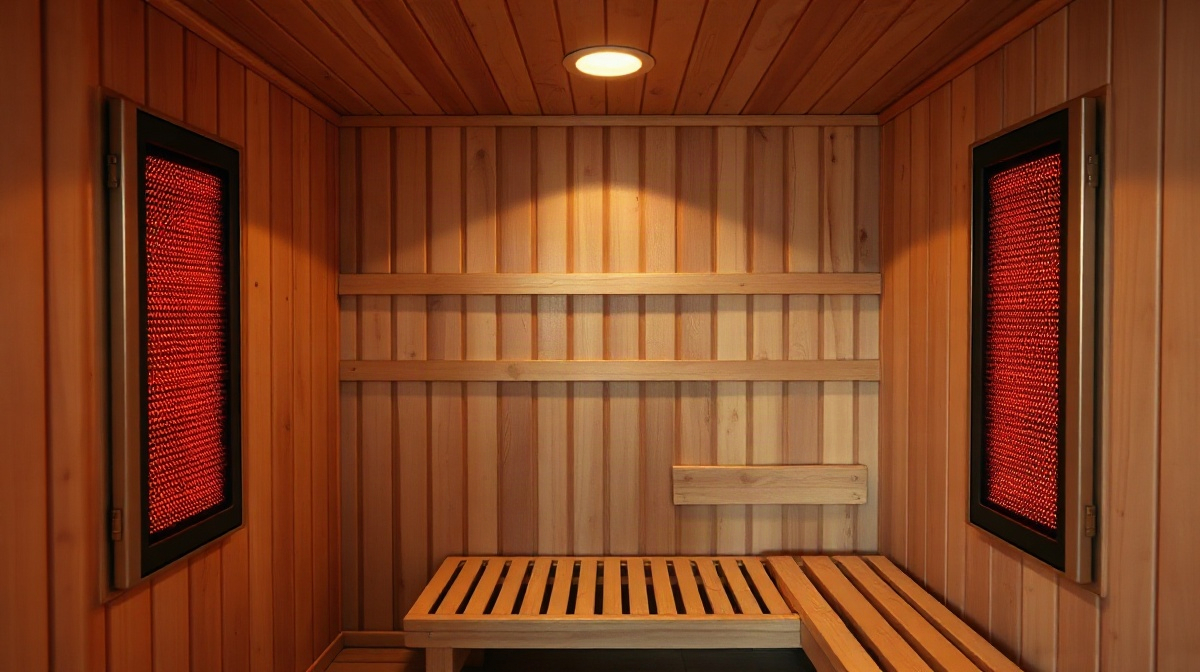
Disclosure We may earn a commission from links on this page, at no extra cost to you — and we only recommend gear we'd stand behind. How this works.
Dynamic Saunas Elite 1-Person Infrared Sauna with Red Light Therapy
Best for Solo users wanting a credible full-spectrum (FIR + red-light NIR) step-up at the lowest realistic entry price
The strongest full-spectrum entry point at this price. Best solo buy in the category.
The good
- Dedicated red-light therapy panels alongside carbon FIR heaters — the combination that maps most directly onto existing photobiomodulation and FIR research
- 4.6 stars from 702 reviews is a meaningful, trustworthy sample
- Reviewers describe fast heat-up and note red-light panels operate independently of FIR heaters
The catch
- One-person capacity only — not suitable for couples or sharing
- NIR irradiance figures not published on the listing or spec sheet; contact manufacturer directly
Joyous 2 Person Home Infrared Sauna with Chromotherapy Light
Best for Two-person households wanting an infrared cabin with chromotherapy at a mid-range price
Best two-person value pick. Solid track record; verify NIR specs before purchase if that wavelength is your primary reason for buying.
The good
- Largest review sample of any two-person unit in this roundup — 1,400 reviews at 4.5 stars as of July 2025
- Two-person capacity with chromotherapy lighting included
- Reviewers repeatedly mention comfortable interior dimensions and easier-than-expected assembly
The catch
- Detailed NIR-output specs not published on the listing — buyers seeking quantified irradiance should verify with manufacturer
- Not the lowest EMF option if that is a priority
LifePro Rejuvacure 1 or 2 Person Indoor Sauna, Red Light, Low EMF
Best for EMF-conscious buyers who want red-light integration and low-EMF certification documentation
Best premium Amazon pick for EMF-sensitive buyers. Pay the premium only if low-EMF certification matters to you specifically.
The good
- Explicitly markets low-EMF output with documentation — rare at this price tier
- Red-light panels plus FIR carbon heaters for genuine full-spectrum output
- Reviewers specifically note that EMF documentation arrived with the unit
The catch
- Highest price of the Amazon options reviewed here
- Smaller review sample (156 reviews) than the Joyous — wait for the rating to hold before treating it as settled
Ceramic Infrared Sauna 2 Person w/ Red Light Therapy
Best for Buyers who prefer ceramic heater intensity over carbon panel evenness, and want red-light therapy in a two-person unit
A strong alternative if you prefer ceramic heat intensity. The lower review count means hold off on calling it best-in-class until the rating stabilizes.
The good
- Highest rating (4.7 stars) of any unit in this roundup
- Ceramic heaters run hotter and deliver more intense radiant heat than carbon panels
- Red-light therapy panels included
The catch
- 135 reviews — a thin base; wait for more data before trusting the 4.7 as a reliable signal
- Ceramic heat distribution can be less even than carbon; some users find it too intense near heaters
OUTEXER Far Infrared Sauna Home Sauna Spa Room Canadian Hemlock 1200W
Best for Budget buyers whose primary goal is FIR deep heat and sweat — not NIR photobiomodulation
The benchmark far-only buy. If you don't specifically need NIR, this saves you several hundred to over a thousand dollars over full-spectrum options, with stronger clinical backing for its wavelength band.
The good
- Canadian hemlock construction at sub-$900 — competitive build quality for the price
- 4.6 stars from 582 reviews; reviewers call out even heat distribution and solid assembly
- 1200W heater spec is clearly published
The catch
- Far-infrared only — no near-infrared or red-light therapy output
- Not a full-spectrum unit; included here as the value benchmark
Sweat Kingdom Custom US-Built Saunas
Best for Buyers who want a permanent, made-to-order US-built sauna installation and can invest well beyond entry-level kits
The right call for buyers who want a permanent, premium installation and have the budget. Not for anyone shopping in the $1,000–$2,500 range.
The good
- Made-to-order in the US — not a flat-pack import kit
- Wide configuration range: solo, 2-person, and group cabins
- Direct manufacturer support for custom installation
The catch
- Starting price around $5,000 — a very different budget tier from Amazon options
- Full spec sheets (heater type, EMF, wavelength output) not universally published publicly; request before ordering
Most infrared sauna listings claim “full-spectrum” output without publishing a single irradiance figure. That silence should be the first thing you notice when comparing cabins.
What does “full spectrum” mean in an infrared sauna?
Infrared radiation splits into three bands per the International Commission on Illumination (CIE S 017/E:2020, the International Lighting Vocabulary): near-infrared (NIR, roughly 0.78–1.4 µm), mid-infrared (MIR, roughly 1.4–3 µm), and far-infrared (FIR, roughly 3–1000 µm). A cabin that markets itself as full-spectrum claims to produce meaningful output across all three at once — typically by pairing carbon panel heaters (which dominate in FIR) with dedicated NIR emitters or red-light panels. MIR sits between the other two bands; it gets the least attention in marketing and the least scrutiny in peer-reviewed sauna research.
Far-infrared-only cabins are the most common and cheapest type. They concentrate almost entirely in the FIR band, producing the deep, radiant warmth most people associate with infrared saunas. Tissue penetration depth varies by wavelength and tissue type — commonly cited figures are approximations for soft tissue at specific wavelengths, not universal constants; treat them as rough orders of magnitude. Near-infrared, at the shorter-wavelength end, has shallower tissue penetration and a distinct photobiomodulation mechanism — closer to red-light therapy than to simple heat absorption.
FIR is primarily a thermal therapy. NIR works through both heat and a photo-chemical pathway. They’re not interchangeable, and more is not automatically better.
Does the research support full-spectrum over far-only?
The marketing is almost never precise about this, so let’s be.
The clinical literature on FIR is deeper and more sauna-specific than anything available for NIR or MIR in cabin settings. A 2015 study in SpringerPlus examined FIR therapy’s effects on fatigue and vascular outcomes — finding reductions in fatigue scores and improvements in vascular access flow, though the authors flagged that most trials were small. A 2018 paper in Evidence-Based Complementary and Alternative Medicine found repeated FIR sauna sessions associated with improved left ventricular ejection fraction in patients with chronic heart failure. Neither study required a full-spectrum source. A standard FIR cabin produces the documented wavelengths just fine.
Near-infrared photobiomodulation has its own research base — but most of it comes from targeted red-light therapy devices operating at specific, controlled irradiances, not sauna cabins. Research suggests NIR and red-light therapy may be associated with upregulation of cellular ATP production and effects on skin tissue in controlled settings (per reviews in Photomedicine and Laser Surgery, 2012 and 2013). The problem with translating that to a cabin: those studies used stationary, calibrated lab devices where irradiance, distance, and exposure time were all fixed. In a sauna, you’re moving around, panels are mounted at varying distances, and session length isn’t standardized. Sauna-specific NIR trials haven’t been run. Anyone chasing skin or collagen outcomes should try to get NIR irradiance specs directly from the manufacturer — most don’t publish them.
Mid-infrared is the least-studied band in sauna contexts. Some manufacturers claim it penetrates joints more effectively than FIR; peer-reviewed, sauna-specific data on that claim is thin.
Full-spectrum marketing is mostly selling NIR you probably won’t be able to measure. Far-infrared has the deepest pool of sauna-specific clinical evidence and does the heavy lifting in every cabin regardless of spectrum. Full-spectrum adds NIR and MIR output — there’s a plausible physiological mechanism, not proof, and the evidence that does exist comes from controlled device studies, not cabins. Most manufacturers won’t give you the irradiance figures needed to know whether their NIR panels are delivering anything close to a therapeutic dose. This article does not constitute medical advice. Check with a doctor before using any sauna for a health condition.
How do full-spectrum cabins compare to far-only on price?
At the entry level, a solid far-infrared cabin — like the OUTEXER Far Infrared Canadian Hemlock unit — retailed around $899.99 as of July 2025. Credible full-spectrum cabins with dedicated NIR or red-light panels start closer to $1,478 (the Ceramic 2-Person unit reviewed below) and run to $2,399.99 for the LifePro Rejuvacure. That’s a meaningful gap over the OUTEXER for a comparable single-occupant or two-person footprint — and it widens further if you move to custom installs.
Custom, US-built full-spectrum options occupy a different tier entirely. Sweat Kingdom’s made-to-order cabins start around $5,000 depending on configuration — aimed at buyers who want a permanent, premium installation, not a flat-pack kit.
Which full-spectrum infrared saunas are actually worth buying?
Amazon ratings and review volumes below reflect data pulled in July 2025 — a snapshot, not gospel. We evaluated products on heater type, value at price point, and published specs. For verified buyer feedback, we looked specifically at recurring complaints about heat-up time, assembly difficulty, and off-gassing — the issues that tend to show up in volume when a product has a real structural problem — and at whether positive reviews described consistent temperature performance or just general satisfaction.
One issue cuts across every Amazon listing reviewed here: none of them publish NIR irradiance figures. Not milliwatts per square centimeter, not beam angle, nothing. We tell buyers below to demand those specs from manufacturers because that’s the right advice — but go in expecting most of them to either ignore the request or send a marketing brochure instead.
For buyers who mainly want heat: far-infrared is still the right call
The OUTEXER Far Infrared Sauna (B0C688XBZR, $899.99 as of July 2025) is not a full-spectrum unit. It earns its place here as a benchmark. Canadian hemlock construction, 1200W heater, 4.6 stars across 582 reviews. Reviewers call out even heat distribution and praise the build quality for the price. If deep heat and sweat are your primary goals, this is what you’re measuring full-spectrum units against — at roughly half the price.
Best full-spectrum step-up: Dynamic Saunas Elite
The Dynamic Saunas Elite 1-Person Infrared Sauna with Red Light Therapy (B0FLWMT968, $1,499.99 as of July 2025) carries 4.6 stars from 702 reviews — a solid sample at this price tier. The spec sheet lists dedicated red-light therapy panels alongside carbon far-infrared heaters, which is the combination that maps most directly onto the existing photobiomodulation and FIR research. Reviewers on the Amazon listing describe fast heat-up times and note that the red-light panels run independently of the FIR heaters — at least consistent with how a functional NIR system would operate, though without published irradiance figures, you can’t confirm therapeutic dose.
One hard limit: it’s a one-person unit, full stop. Buying for two means looking elsewhere.
Best two-person full-spectrum value: Joyous 2-Person with Chromotherapy
The Joyous 2 Person Home Infrared Sauna with Chromotherapy Light (B00F2Y5B6W, $2,199 as of July 2025) has 1,400 reviews at 4.5 stars — the largest verified buyer base of any two-person unit in this roundup. Chromotherapy lighting is included. The heater array is infrared carbon panel. Two complaints surface repeatedly in the review base: minor assembly confusion around door alignment, and a short-lived smell during the first few sessions that buyers attribute to wood off-gassing. Both are common to flat-pack wood cabins and neither points to a structural problem, but they’re worth knowing going in. Comfortable interior dimensions and straightforward assembly were the most commonly praised specifics.
What it doesn’t give you: any NIR-output figures. The Amazon listing publishes none. Buyers specifically chasing quantified NIR irradiance should contact Joyous directly before purchasing — though see above for what to realistically expect from that conversation. Two-person cabin space at $2,199 is solid value for the size, but this is not the unit to buy if NIR is your primary motivation and you need numbers to back it up.
Best two-person premium: LifePro Rejuvacure
The LifePro Rejuvacure 1 or 2 Person Indoor Sauna with Red Light and Low EMF (B0FMYW3DVX, $2,399.99 as of July 2025) explicitly markets low-EMF output alongside red-light integration — and LifePro claims to have certification documentation for it, which reviewers specifically note arrived with the unit. That’s uncommon at this price tier and directly relevant to buyers who’ve been burned by listings that gesture at “low EMF” without anything on paper to back it up. The caveat: 156 reviews is a thinner base than we’d like; we’d wait to see the rating hold before treating it as settled. Not a budget pick. Anyone not prepared to spend north of $2,000 for a two-person unit should stop here.
Ceramic panel alternative: 2-Person Ceramic Infrared Sauna
Carbon panels and ceramic heaters are not interchangeable. Ceramic runs hotter and delivers more intense radiant heat; carbon spreads it more evenly across the cabin walls. If you’ve ever found radiant heat too aggressive near the source, that intensity is worth factoring in — reviewers on ceramic listings fairly consistently mention that the sweet spot is the center of the bench, away from the elements. The Ceramic Infrared Sauna 2 Person with Red Light Therapy (B0GL85JR6T, $1,478 as of July 2025) is the highest-rated unit in this roundup at 4.7 stars. The catch: only 135 reviews back that number. That’s too thin a base to trust the 4.7 as a reliable signal yet — check back in six months. Red-light therapy panels are included, and the price is competitive for a two-person ceramic unit.
Premium/custom pick: Sweat Kingdom (Direct-Brand Partner)
Disclosure: Sweat Kingdom has a paid affiliate relationship with this site — we earn a commission on purchases made through our link. That relationship did not determine the editorial placement here. Sweat Kingdom is included because it represents a genuinely different product tier — US-built, made-to-order, with direct manufacturer support — that no Amazon flat-pack option replicates. We have not independently verified their spec documentation, and at $5,000 and up, you should request detailed heater-type, EMF, and wavelength documentation before ordering. That request isn’t optional at this price.
Sweat Kingdom is not an Amazon product. Made-to-order, US-built, starting around $5,000 depending on configuration. This is for the buyer who wants a permanent installation with direct manufacturer support — not someone comparing flat-pack kits. Sweat Kingdom does not publish full spec sheets publicly for every model.
Is the full-spectrum premium worth it?
For solo buyers: the Dynamic Saunas Elite is the clearest answer. You get FIR heat plus independent red-light panels at $1,499.99 — roughly $600 more than the OUTEXER benchmark, with a plausible (if unproven-in-cabin) NIR mechanism on top. Most solo buyers who want both modalities should start there.
For two-person households, the math changes. The Joyous at $2,199 has the deepest review track record in this roundup; the LifePro at $2,399.99 is the pick if EMF documentation is a genuine requirement. Those are different needs, and they don’t overlap much. Figure out which one applies to you before spending.
If deep heat, sweat, and cardiovascular warmth are the only goals, the far-infrared-only OUTEXER saves you several hundred to over a thousand dollars and is backed by the stronger body of sauna-specific clinical research for its wavelength band. That’s not a consolation prize — it’s the honest answer for most buyers.
Before committing to any full-spectrum unit, ask the manufacturer for published wavelength and EMF specs. If they can’t produce irradiance figures for their NIR panels, you now know exactly what that silence means.
Frequently asked questions
Is a full-spectrum infrared sauna better than a far-infrared sauna?
It depends on your goals. Far-infrared has the stronger body of sauna-specific clinical research behind it — most published studies on infrared sauna and cardiovascular or pain outcomes used FIR sources. Full-spectrum adds near-infrared (NIR) output, which has separate research support in photobiomodulation (skin, cellular energy) — but that evidence comes largely from controlled device studies, not sauna cabins. Research suggests these mechanisms are plausible, but they are not proven in cabin settings. If deep heat and sweat are your primary goals, a quality far-infrared cabin is not inferior. If you specifically want the NIR photobiomodulation research, a verified full-spectrum unit with red-light panels is the more targeted tool. This is not medical advice; consult a physician for health-related decisions.
What wavelengths does a full-spectrum infrared sauna emit?
A genuine full-spectrum sauna emits near-infrared (roughly 0.78–1.4 µm), mid-infrared (roughly 1.4–3 µm), and far-infrared (roughly 3–1000 µm), per the International Commission on Illumination's CIE S 017/E:2020 infrared band definitions. Most consumer cabins achieve this using carbon panel heaters for FIR output combined with dedicated NIR emitters or red-light LED panels. Buyers should request exact wavelength and irradiance specs from the manufacturer, as 'full-spectrum' is a marketing term with no regulatory definition.
How much does a full-spectrum infrared sauna cost?
Full-spectrum infrared sauna cabins on Amazon ranged from approximately $1,478 (ceramic two-person units) to $2,399.99 for premium low-EMF models as of July 2025. Custom US-built options from brands like Sweat Kingdom start around $4,000 for standard configurations. Far-infrared-only cabins are available from around $900. All prices are subject to change — check current listings before purchasing.
Are full-spectrum infrared saunas safe?
This article does not constitute medical advice. For healthy adults, infrared sauna use is generally considered low-risk when sessions are kept to commonly recommended durations and adequate hydration is maintained. A 2018 review in Mayo Clinic Proceedings noted that sauna bathing appears safe for most people, including those with stable cardiovascular conditions, though it cautioned against use for people with certain acute conditions or during pregnancy. Anyone with a medical condition should consult a physician before using any sauna, full-spectrum or otherwise. EMF output varies significantly between units; buyers concerned about EMF exposure should request third-party EMF test documentation from the manufacturer.
What is the difference between near, mid, and far infrared in a sauna?
Near-infrared (NIR) has the shortest wavelength (~0.78–1.4 µm), the shallowest tissue penetration, and operates partly through photobiomodulation — a photo-chemical process studied in the context of skin health and cellular energy, though sauna-specific NIR trials have not been conducted. Far-infrared (FIR) has the longest wavelength (~3–1000 µm) and produces the deep radiant warmth most people associate with infrared saunas; this is the band covered by most clinical sauna research. Tissue penetration depth varies by wavelength and tissue type — treat commonly cited figures as rough approximations. Mid-infrared (MIR) sits between them and is the least studied in sauna-specific contexts. Most of the heat and sweat in any infrared sauna session comes from the FIR band.
Sources
- Infrared Radiation — Band Definitions, CIE S 017/E:2020 International Lighting Vocabulary, 2nd Edition — International Commission on Illumination (CIE)
- Far-Infrared Therapy: A Novel Treatment to Improve Access Blood Flow and Unassisted Patency of Radiocephalic Fistulas — SpringerPlus 2015 — SpringerPlus / PubMed Central
- Far-Infrared Sauna and Heart Failure — Evidence-Based Complementary and Alternative Medicine 2018 — Evidence-Based Complementary and Alternative Medicine / PubMed Central
- Low-Level Laser (Light) Therapy (LLLT) on Muscle Tissue: Performance, Fatigue and Repair — Photomedicine and Laser Surgery 2012 — Photomedicine and Laser Surgery / PubMed Central
- Photobiomodulation and Near-Infrared Light — Review, Photomedicine and Laser Surgery 2013 — Photomedicine and Laser Surgery
- Clinical Effects of Regular Dry Sauna Bathing — Mayo Clinic Proceedings 2018 — Mayo Clinic Proceedings
- Dynamic Saunas Elite 1-Person Infrared Sauna with Red Light Therapy — Amazon listing B0FLWMT968 — Amazon
- Joyous 2 Person Home Infrared Sauna with Chromotherapy Light — Amazon listing B00F2Y5B6W — Amazon
- LifePro Rejuvacure Sauna — Amazon listing B0FMYW3DVX — Amazon
- Ceramic Infrared Sauna 2 Person w/ Red Light Therapy — Amazon listing B0GL85JR6T — Amazon
- OUTEXER Far Infrared Sauna Canadian Hemlock 1200W — Amazon listing B0C688XBZR — Amazon
- Sweat Kingdom Saunas Collection — Sweat Kingdom