Guides
How Cold Should a Cold Plunge Be?
Exact temperature and duration ranges for cold plunging, from beginner-safe starting points to advanced protocols — backed by published research and expert guidance.
Disclosure We may earn a commission from links on this page, at no extra cost to you — and we only recommend gear we'd stand behind. How this works.
The Cold Pod Ice Bath Tub for Athletes XL: Cold Plunge Tub Outdoor with Cover, 116 Gallons
Best for Most adults wanting a spacious, affordable home plunge tub
The best overall entry point for home cold plunging. Spacious, well-reviewed, and the cover is a genuine usability plus for outdoor setups.
The good
- 116-gallon capacity fits adults up to ~6'4"
- Included insulating cover helps hold temperature between sessions
- Strong review volume (518+ reviews) for this price tier
The catch
- No built-in chiller — requires ice or cold tap fill
- Larger volume means more ice needed to reach target temps
The Cold Pod Cold Plunge Tub: 85 Gal Round Tub with Full-Wrap UV-Reflective Insulation Cover Bundle
Best for Outdoor use where sun exposure is a concern
Best for outdoor plungers dealing with direct sunlight. The UV-reflective cover isn't just marketing — it solves a real temperature-maintenance problem.
The good
- Full-wrap UV-reflective insulation cover is a genuine differentiator for outdoor setups
- Highest review count in this list (1,000+) at 4.3 stars
- Compact round footprint works well on smaller decks or patios
The catch
- Smaller 85-gallon capacity — tighter fit for taller users
- Higher price than comparably-sized competitors
Bubplay Ice Bath Cold Plunge Tub with Cover for Indoor Outdoor, 105 Gallons, XL
Best for Budget-conscious beginners testing cold plunging for the first time
The honest pick for anyone who isn't sure yet. If you decide cold plunging isn't for you, you're not out much. If you stick with it, upgrade later.
The good
- Under $45 makes it easy to try before committing to a premium setup
- 739 reviews at 4.3 stars is a strong signal at this price
- 105-gallon capacity is genuinely spacious
The catch
- Thinner construction means higher ice consumption to maintain temp
- Not built for years of heavy daily use
BINYUAN XL Ice Bath Tub for Athletes With Cover 99 Gal Cold Plunge Tub
Best for Beginners wanting slightly better build quality without breaking triple digits
A meaningful step up from the cheapest options without a steep price jump. Good for regular use at an entry-level budget.
The good
- Multi-layered construction offers improved insulation over single-layer budget tubs
- Cover included
- 454 reviews at 4.3 stars is solid for this price
The catch
- Still no chiller — ice required
- Some owners report the cover fit is slightly loose
Portable Inflatable Cold Plunge Tub for Athletes & Adults (B0CTKWQK72)
Best for Apartment dwellers or anyone with limited outdoor/storage space
The only real option if storage is a constraint. The stated 5-year assurance addresses the main concern. Not ideal for daily outdoor use.
The good
- Inflatable design stores flat when not in use
- Works indoors where rigid tubs are awkward
- 5-year assurance listed on product page
The catch
- Inflatable construction raises long-term durability questions
- Less thermally efficient than rigid-walled tubs
The Mayo Clinic Health System is direct about it: water should be 50°F or colder for a true cold plunge, and you should measure it — not guess. That single sentence is more useful than most cold-plunge content online, which throws wide ranges at readers without explaining why the numbers matter or how to move through them safely.
What temperature range is considered a “real” cold plunge?
The Cleveland Clinic defines cold-water immersion as water at or below 59°F (15°C). Below that threshold, the body initiates a meaningful cold-shock response: heart rate spikes, breathing quickens, peripheral blood vessels constrict. At 60°F and above, you get a cool soak — pleasant, but a different physiological stimulus entirely.
In practice, most people cold plunge somewhere in this range:
- 55–59°F (13–15°C) — The beginner-accessible zone. Cold enough to produce a real response, forgiving enough to let you control your breathing and stay in for 1–3 minutes without significant risk.
- 50–54°F (10–12°C) — Where many regular plungers settle. Research published in the European Journal of Applied Physiology (Shattock & Tipton, 2012) examined human physiological responses to cold-water immersion and documented significant autonomic and cardiovascular effects in this temperature range.
- 45–49°F (7–9°C) — Advanced territory. Commonly used by athletes for post-training recovery, with many protocols capping sessions at 90 seconds to 3 minutes.
- Below 45°F (below 7°C) — The Cleveland Clinic advises against going below 40°F (4°C). Open-water swimmers and extreme practitioners sometimes operate here, but at these temperatures unsupervised solo sessions carry real risk.
A 2022 systematic review in PLOS ONE (Yankouskaya et al., DOI: 10.1371/journal.pone.0277964) analyzed data from 3,177 participants and found that water temperatures across studies typically ranged from 50–59°F (10–15°C), with research suggesting mood improvement and perceived recovery benefits in that band.
How long should you stay in?
Temperature and duration aren’t separate variables — they compound. A 3-minute plunge at 55°F delivers a very different stimulus than 3 minutes at 45°F. You can’t optimize one without knowing the other.
A frequently cited weekly target in cold-exposure discussions is 11 minutes of total cold exposure per week, divided across 2–4 sessions. It’s worth being clear about what that is and isn’t: this is a protocol synthesized by the Huberman Lab from existing studies and communicated via podcast and newsletter, not a figure from a single peer-reviewed clinical trial. At 50–55°F, it maps to roughly 2–4 minutes per session.
Beginners (first 2–4 weeks) Start at 55–59°F. Aim for 1–2 minutes. The goal is breath control and acclimation — not time records. If you can’t slow your breathing within the first 30 seconds, the water may be too cold for where you are right now, or you’ve simply stayed in too long.
Intermediate (1–3 months in) Many people drop to 50–54°F and extend to 3–5 minutes as cold tolerance builds. Individual variation is real, so progress at a pace that feels controlled.
Advanced (3+ months, consistent practice) 45–50°F, 2–5 minutes per session. Some protocols extend to 10 minutes at higher temperatures (around 57°F) for specific endurance-recovery applications — but that’s outside what most people should target at the start.
At every level: get out before shivering becomes uncontrolled. The Cleveland Clinic explicitly flags uncontrolled shivering as a signal to exit immediately.
Does colder always mean better?
No. This is where a lot of popular cold-plunge content goes wrong.
Research suggests that very cold water (below 50°F) is not demonstrably more effective for the outcomes most people care about — mood, alertness, perceived recovery — than water in the 50–59°F range. The stimulus needs to be cold enough to produce a genuine cold-shock response. Beyond that threshold, going colder adds risk without adding proportional benefit.
There’s also a specific concern worth flagging for post-workout use. A meta-analysis in the British Journal of Sports Medicine (Tseng et al., 2022, DOI: 10.1136/bjsports-2021-104498) found that cold-water immersion can blunt muscle protein synthesis when used immediately after strength training. If your goal is muscle hypertrophy, plunging right after lifting may work against you. For recovery from endurance work or reducing perceived soreness, research suggests more favorable outcomes — though always consult a qualified professional for personalized guidance.
Who should NOT cold plunge?
The following populations should consult a physician before cold plunging — and this isn’t boilerplate:
- Anyone with cardiovascular disease or arrhythmia. Cold water causes an immediate spike in blood pressure and heart rate.
- Individuals with Raynaud’s disease or poor peripheral circulation.
- People with open wounds or active skin infections.
- Pregnant individuals.
- Anyone currently unwell or running a fever.
This article is not medical advice. Always consult a qualified healthcare provider before starting cold-water immersion, particularly if you have any underlying health condition.
The Cleveland Clinic also notes that the cold-shock response itself — gasping, hyperventilation — is a primary drowning risk in cold water. Don’t plunge alone if you’re new to it.
How to actually hit the right temperature at home
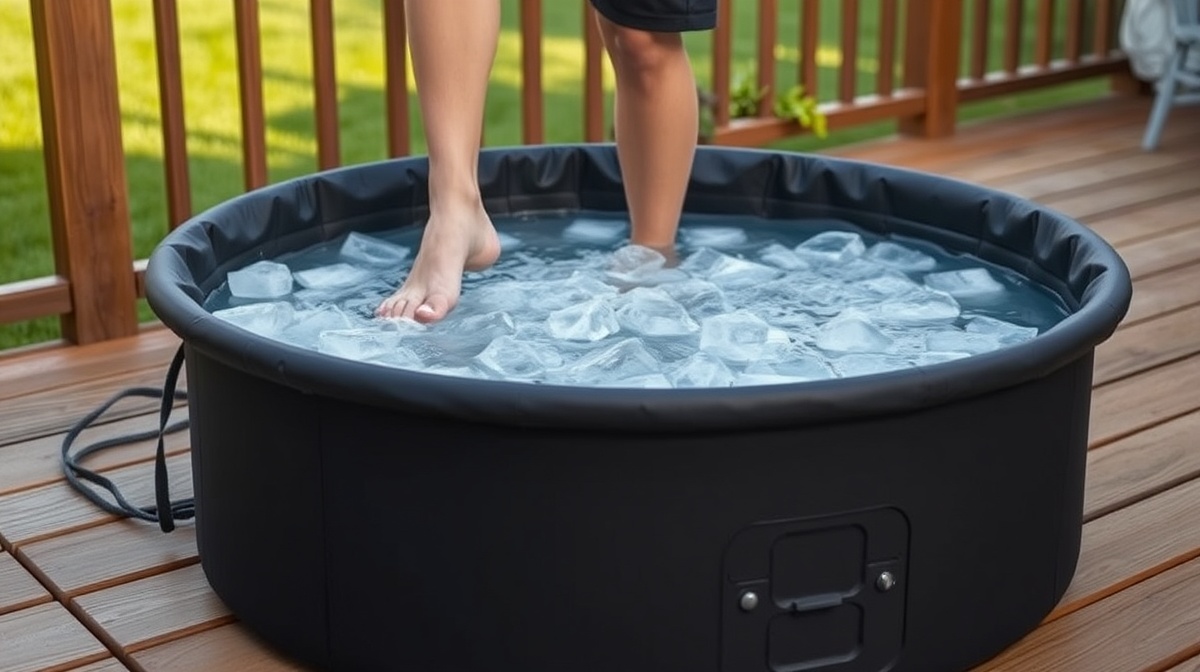
If you’re using a basic portable tub without a built-in chiller, you’re working with ice and tap water. Cold plunge community forums commonly suggest roughly 20–40 lbs of ice (one to two standard bags) per 85–100 gallons as a rough starting point for reaching the 50–55°F range, though starting tap temperature varies enough by region and season that this is not a reliable formula. Use a floating thermometer every time. The math changes more than people expect.
For consistent, repeatable temperatures without the ice routine, a tub with an insulated cover makes a real difference in day-to-day usability. Most portable tubs under $200 have no chiller — you’re relying on ice or cold tap fill. That’s fine for most people starting out. Just account for it in your setup.
Portable cold plunge tubs worth considering
These are well-reviewed portable tubs available on Amazon for home cold plunging. Prices were verified as of July 2026 and will shift — verify before buying.
The Cold Pod XL (116 Gal)
A consistent top seller with 518+ reviews at 4.2 stars (as of July 2026). The 116-gallon capacity fits most adults up to 6’4”, per the product listing. Owners frequently highlight the included cover as a genuine advantage for holding temperature between sessions — which matters more than it sounds if you’re plunging daily. Not a chiller unit; ice or cold fill required.
The Cold Pod Round Tub (85 Gal) with UV-Reflective Cover
Smaller footprint, better for tight spaces. The full-wrap UV-reflective insulation cover is the real differentiator here — it addresses a specific problem for outdoor setups where sun exposure would otherwise warm the water. Over 1,000 reviews at 4.3 stars (as of July 2026). The smaller 85-gallon volume is a constraint for taller users, worth knowing before you buy.
Bubplay Ice Bath (105 Gal)
The budget standout in this category. Hard to argue with for anyone who wants to try cold plunging before committing to a more expensive setup. 739 reviews at 4.3 stars (as of July 2026) is a credible signal for a tub at this price point. Owners note it uses more ice than sturdier alternatives — thinner walls mean the water warms faster. That’s the real trade-off, not a defect exactly, just physics.
BINYUAN XL (99 Gal)
Multi-layered construction with a cover included, 454 reviews at 4.3 stars (as of July 2026). Priced below triple digits at time of writing. A meaningful step up from the Bubplay in build quality without a steep price jump — good for regular use if you’ve decided cold plunging is sticking.
Portable Inflatable Cold Plunge Tub (B0CTKWQK72)
An inflatable format worth including because storage constraints are a real barrier for apartment users. 437 reviews at 4.2 stars (as of July 2026). The product page lists a 5-year assurance, which is worth noting given that inflatable tubs attract legitimate durability skepticism. It stores flat when not in use, which rigid tubs don’t. Thermally less efficient than a rigid-walled tub, but that’s not the point — the point is it fits where nothing else does.
The short version
50–59°F is where most evidence points. Beginners start at the warmer end and keep sessions short. Advanced users work colder over time, carefully. Below 40°F is not a goal — it’s a risk category. Measure the water every time, stay consistent across weeks, and resist the urge to treat colder as automatically better. Consistency over time is what produces adaptation. One brutal session doesn’t.
Frequently asked questions
What temperature is too cold for a cold plunge?
The Cleveland Clinic advises against going below 40°F (4°C). Below that threshold, the risk of cold shock, hyperventilation, and cardiovascular stress rises significantly with very little additional physiological benefit over the 50–59°F range most research supports.
How long should a beginner stay in a cold plunge?
1–2 minutes at 55–59°F is an appropriate starting point. The goal in early sessions is breath control and acclimation, not duration. Many protocols build toward 2–4 minutes per session over several weeks. The Huberman Lab synthesizes existing research literature around a cumulative weekly target of roughly 11 minutes across 2–4 sessions — note this is a protocol synthesized from studies and communicated via podcast, not a figure from a single clinical trial.
Is 60°F cold enough for a cold plunge?
Technically, 60°F sits just above the threshold most clinical definitions use for cold-water immersion (typically 59°F/15°C or below). It can be a reasonable starting point for very first sessions to get used to the sensation, but most research on physiological benefits uses temperatures at or below 59°F.
Should I cold plunge before or after a workout?
It depends on your goal. For endurance recovery and soreness reduction, research suggests post-workout cold plunging may be beneficial. For strength and muscle-building goals, a meta-analysis in the British Journal of Sports Medicine (Tseng et al., 2022, DOI: 10.1136/bjsports-2021-104498) found that immediate post-workout cold immersion can blunt muscle protein synthesis — so waiting several hours or plunging on rest days may be the better approach. Consult a qualified professional for personalized guidance.
How much ice do I need for a cold plunge tub?
Cold plunge community forums commonly suggest roughly 20–40 lbs of ice (one to two standard bags) per 85–100 gallons as a starting point, though starting tap water temperature varies enough by region and season to make any fixed formula unreliable. Always verify with a floating thermometer.
Sources
- Cold-water plunging health benefits — Mayo Clinic Health System
- Are 'Cold Plunge' Ice Baths Good for You? — Cleveland Clinic
- Shattock & Tipton: Human physiological responses to cold-water immersion (DOI: 10.1007/s00421-012-2523-5) — European Journal of Applied Physiology
- Tseng et al.: Effects of cold-water immersion on recovery of physical performance and muscle damage indicators — meta-analysis (DOI: 10.1136/bjsports-2021-104498) — British Journal of Sports Medicine
- Yankouskaya et al.: Cold water immersion: kill or cure? Systematic review (DOI: 10.1371/journal.pone.0277964) — PLOS ONE
- Huberman Lab: Using Cold Exposure for Health and Performance — Huberman Lab
- Cold Plunges: Health Benefits, Risks And More — Forbes Health