Cold Plunge
Best Ice Bath Chillers: No Ice, No Hassle
Independent comparison of ice bath chillers by cooling power, noise, and cost-per-use. Find the right chiller unit or tub setup for your cold plunge routine.
Disclosure We may earn a commission from links on this page, at no extra cost to you — and we only recommend gear we'd stand behind. How this works.
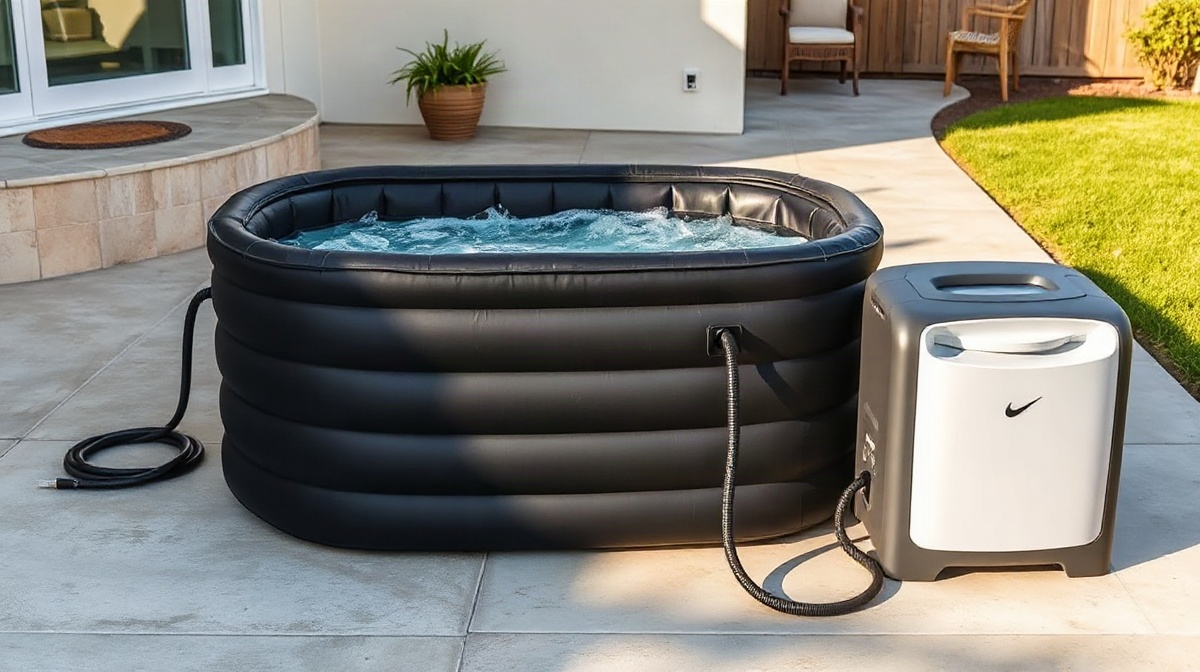
VEVOR Cold Plunge Tub, 216 Gallon, Inflatable Ice Bath Tub Compatible with Water Chillers
Best for Building a chiller-ready cold plunge setup on a budget
The most practical tub on this list for pairing with a standalone chiller — the built-in ports and insulated lid do real work. Best for indoor or covered-patio use where a ½ HP chiller can keep up.
The good
- Chiller-port ready with inlet/outlet fittings
- Insulated lid included — reduces heat gain between sessions
- 216-gallon volume accommodates most adult body sizes fully submerged
The catch
- No chiller unit included
- Inflatable walls less rigid than hard-shell alternatives
- Large volume means underpowered chillers struggle in warm climates
The Cold Pod Cold Plunge Tub, 85 Gal Round Tub with Full-Wrap UV-Reflective Insulation Cover Bundle
Best for Compact indoor setups or users running a lower-horsepower chiller
A solid compact option. The smaller volume is an advantage for chiller efficiency — a ½ HP unit will hold temperature here more reliably than in a 200+ gallon tub. Verify port compatibility before committing.
The good
- Smaller 85-gallon volume cools faster with a given chiller
- UV-reflective cover reduces heat gain for outdoor use
- Strong review volume (1,000+) with consistent durability reports
The catch
- No dedicated chiller ports confirmed in spec sheet — verify compatibility
- Round shape limits legroom for taller users
- 85 gallons may feel cramped for larger frames
Ouster 3in1 Cold Plunge Water Treatment, Weekly Cleaner, 32oz
Best for Keeping chiller-cooled water clean without integrated UV/ozone filtration
If your chiller setup lacks built-in sanitation, this is the simplest and cheapest fix. Not glamorous, but it solves a real problem.
The good
- Simple weekly dosing — no complex chemistry required
- Owners consistently report clear, odor-free water between changes
- Inexpensive way to extend water change intervals
The catch
- Not a substitute for proper filtration in high-use setups
- 32 oz may not last as long as expected with larger tub volumes
Extra Large Ice Block Molds 4 Pack 32LB for Cold Plunge Tub
Best for Supplementing a chiller in extreme heat or during power outages
Cheap insurance for hot climates or outages. A ½ HP chiller can struggle past 95°F ambient — these blocks buy it time.
The good
- Block ice melts more slowly than cubed ice
- Highest-rated product in this roundup at 4.6★
- One-time cost with no ongoing expense beyond electricity to freeze
The catch
- Requires freezer space for large blocks
- Not a replacement for a powered chiller in regular use
At $4–6 per 20-lb bag, and a standard cold plunge tub needing 40–80 lbs to push water under 50°F, the annual ice bill for three sessions a week can add up quickly. That’s before you factor in hauling bags, managing melt schedules, and dealing with the inevitable warm plunge because you forgot to restock. A dedicated chiller eliminates all of it.
This guide focuses on the mechanical chillers themselves: how they work, which specs actually matter, and what honest owner feedback says. Where Amazon-listed products don’t include standalone chiller units — and right now, none of the live US listings in this category include a powered chiller — we’ll say so plainly and point you toward what does exist. No padded product cards to fill a quota.
How does an ice bath chiller actually work?
Most ice bath chillers use vapor-compression refrigeration — the same basic cycle as your refrigerator or a portable AC unit. A refrigerant absorbs heat from the water, runs through a compressor, dumps that heat to the outside air, and cycles back. The output is consistent, adjustable temperature control, typically anywhere from 37°F to 60°F depending on the unit.
Drop-in chillers submerge a heat-exchanger coil directly in your tub. External chillers circulate water through an insulated loop. External units are generally quieter because the compressor sits away from the tub, though they need a few feet of hose and a pump. Either approach gets you to cold.
Cooling capacity is rated in BTUs per hour or horsepower. A ½ HP unit is the most common entry point for home use — it can typically cool 100–200 gallons to around 39°F, though ambient air temperature has a significant effect. Manufacturers usually specify capacity at 80–95°F ambient. If you’re plunging on an uncovered patio in August, those specs will be optimistic.
What specs actually matter when comparing chillers?
Cooling power (BTU/HP). This is the headline number. A ½ HP compressor handles tubs up to roughly 150 gallons in a climate-controlled space. Outdoors in summer? You want ¾ HP or higher.
Target temperature floor. Better units hit 37–39°F. Cheaper or underpowered ones may stall at 50°F. The spec sheet should state minimum water temperature at a defined ambient — if it doesn’t, treat that as a warning sign.
Noise level (dB). Buyers consistently underestimate this. Budget compressors can run 55–65 dB. Premium units with brushless compressors or vibration-dampened housings may achieve lower noise levels. If a chiller doesn’t publish a dB rating, you’re buying blind on the one spec that will affect every single session. Noise is one of the top post-purchase complaints owners cite in reviews for louder units.
Filtration integration. Some chillers include a built-in pump and UV or ozone sanitation. Others are cooling-only and leave filtration entirely to you. Without sanitation, water in a cold plunge tub is commonly reported by owners to need changing every 3–5 days. With UV or ozone, owners commonly report going 2–4 weeks between changes.
Weatherproofing. An IP55 rating — defined under IEC standard 60529 — means the unit is protected against low-pressure water jets, which is relevant for outdoor or humid installations where splash and condensation are constant. Many budget units list no IP rating at all. If the spec sheet is silent on this, assume it’s not rated.
Cost-per-use math. A chiller drawing 500–800W over a 2–3 hour session costs roughly $0.10–$0.20 per session at average US electricity rates (the U.S. Energy Information Administration pegs the national residential average at approximately $0.16/kWh as of the most recent available data). Compare that to $8–$15 in ice per session. A $1,000 chiller can pay for itself within a year for anyone plunging regularly — exact timeline depends on session frequency and local electricity rates.
What does research say about cold water immersion?
Research suggests regular cold water immersion may reduce perceived muscle soreness and support recovery after intense exercise, though effect sizes vary across studies. A review published in the International Journal of Sports Physiology and Performance (2022, Vol. 17, No. 4, pp. 571–580) found that water temperatures between 10–15°C (50–59°F) showed the strongest recovery signals in the reviewed literature. This is not medical advice. Temperatures below 10°C are common in cold plunge practice, but the American Heart Association notes that cold water immersion carries elevated cardiovascular risk for some individuals — consult a physician before starting a cold immersion routine.
Which tubs are compatible with external chillers?
This is where the Amazon product landscape requires honesty: live listings in this category are tubs, molds, and water-treatment products — not powered chillers. Tub selection still matters enormously for chiller compatibility, though, so here’s what’s actually available and what to make of each.
VEVOR 216-Gallon Inflatable Cold Plunge Tub
Best for: anyone building a chiller-compatible setup on a budget
The VEVOR 216-gallon inflatable tub (ASIN B0H668QYPT) is explicitly marketed as compatible with water chillers — the tub features inlet/outlet ports that accept standard chiller hose fittings. At 59.1″ × 31.5″ × 29.9″, it fits most adult users fully submerged to shoulder level. The insulated lid isn’t decorative; owners consistently report it slows warm-up between sessions, which matters a lot at 216 gallons.
At around $220 as of October 2026, it’s one of the more capable budget tubs for pairing with a standalone chiller. One real caveat: 216 gallons is a lot of water to move thermally. If you’re running a ½ HP chiller in a warm climate, don’t expect sub-45°F on a hot patio. This tub rewards either a stronger chiller or a shaded, covered installation.
Pros:
- Chiller-port ready out of the box
- Insulated lid included
- 216-gallon volume suits taller users
Cons:
- No chiller included — obvious, but worth stating
- Inflatable walls offer less structural rigidity than hard-shell tubs
- At 216 gallons, underpowered chillers will struggle in warm climates
Rating: 4.5★ (386 reviews)
The Cold Pod 85-Gallon Round Tub
Best for: compact indoor setups, or anyone running a lower-horsepower chiller
The Cold Pod (ASIN B0F8W817GD) holds 85 gallons. That’s less than half the VEVOR’s volume, and that’s the whole point. A ½ HP unit will cool 85 gallons faster, hold temperature more consistently, and recover from body-heat load more easily than it will 216 gallons — especially in a warm garage where ambient temps work against you. The UV-reflective insulation cover reduces heat gain from direct sun, which is a genuinely useful feature rather than a marketing checkbox.
At around $150 as of October 2026, the full-wrap cover and the round format — which owners report feels comfortable for shoulder immersion — justify the price over bare-minimum inflatables. One thing to verify before purchasing: the spec sheet does not confirm dedicated chiller ports. If you’re planning a hose connection rather than a drop-in coil, confirm compatibility with the seller first.
Pros:
- Smaller volume means faster cool-down with a given chiller
- UV-reflective cover cuts heat gain outdoors
- 4.3★ across 1,000+ reviews points to solid real-world durability
Cons:
- No dedicated chiller ports confirmed in the spec sheet — verify compatibility before purchasing
- Round shape limits legroom for taller users
- 85 gallons can feel cramped for larger frames
Rating: 4.3★ (1,000+ reviews)
Ouster 3-in-1 Cold Plunge Water Treatment
Best for: anyone already running a chiller who needs clean water
Not a tub, not a chiller. The Ouster 3-in-1 (ASIN B0DCKFWYZ6) is a weekly water treatment for cold plunge tubs where UV or ozone filtration isn’t part of the chiller setup — which covers a lot of entry-level rigs. At around $23 as of October 2026 for 32 oz, it’s a low-cost piece of the total system. Owners consistently report clear, odor-free water between weekly changes. If your chiller lacks integrated sanitation, this is the simplest stopgap. It won’t replace proper filtration in a high-use commercial setup, but for a home plunge tub used a few times a week, it does the job.
Rating: 4.5★ (555 reviews)
Extra Large Ice Block Molds (4-Pack, 32 lb)
Best for: supplementing a chiller during extreme heat or power outages
In climates where summer temps regularly push past 100°F, even a capable chiller can struggle to hold sub-50°F water. Large block molds (ASIN B0CQTYQ14N) let you pre-freeze supplemental ice at home. Block ice melts more slowly than cubed ice, and 32-lb blocks can meaningfully affect water temps. At around $30 as of October 2026 for four molds, this is a one-time cost, then only the electricity to run your freezer. At 4.6★ across 641 reviews, it’s the highest-rated product in this roundup.
Rating: 4.6★ (641 reviews)
What should you budget for a powered chiller unit?
Standalone ice bath chillers — the actual refrigeration units — don’t currently appear in Amazon’s US listings at meaningful volume. Direct-to-consumer brands dominate the space: Penguin Chillers (made in Tennessee) and various OEM suppliers. Half-HP units typically start around $500–$800. Three-quarter HP and above, with integrated filtration and app control, typically run $1,500–$5,000. Verify current availability and pricing directly with manufacturers, as this segment changes frequently and falls outside our verified Amazon ASIN set.
Three things matter most regardless of price point: noise rating in decibels, warranty length, and whether the unit carries an IP55 or higher rating if it’s going outside. Skipping that last check on an outdoor install is a common and expensive mistake. An outdoor chiller with no weather rating, exposed to morning dew and summer rain, is a support ticket waiting to happen.
Before you buy: compatibility questions worth answering first
Tub and chiller compatibility is where people get burned most often — sometimes expensively. A few things to work through:
Does your tub have inlet/outlet ports, or will you need a drop-in coil design? The VEVOR 216-gallon has them; the Cold Pod’s spec sheet doesn’t confirm them. That’s not a small difference if you’ve already ordered a hose-connect chiller.
Match chiller HP to tub volume honestly — ½ HP handles up to roughly 150 gallons in a climate-controlled space, not on a sun-baked deck. Manufacturers rate capacity at 80–95°F ambient; if your ambient regularly exceeds that, the published numbers are not promises.
Budget for water treatment if your chiller lacks UV or ozone filtration. Without it, owners consistently report changing water every 3–5 days. The Ouster 3-in-1 runs around $23 for a reason.
Finally, electricity: approximately $0.10–$0.20 per session at US average rates (per EIA data). Across a year of regular use, that’s a modest operating cost compared to ongoing ice purchases.
Frequently asked questions
How cold can an ice bath chiller get the water?
Most quality home-use chillers (½ HP and above) are spec'd to reach 37–39°F (3–4°C) minimum water temperature, measured at a defined ambient air temperature — typically 80–95°F. Cheaper or underpowered units may only reach 50°F. Always check the spec sheet for the minimum temperature and the ambient temperature at which it was measured, since real-world performance drops in hot climates.
Is an ice bath chiller worth it compared to buying ice?
For regular users (3+ sessions per week), the math is favorable. A 40–80 lb ice load costs $8–$15 per session at typical retail prices. A chiller running 2–3 hours draws roughly 500–800W, costing approximately $0.10–$0.20 at US average electricity rates per EIA data. A $1,000 chiller can pay for itself within a year of consistent use, though the exact timeline depends on session frequency and local electricity costs.
How loud are ice bath chillers?
Budget units with standard compressors can run 55–65 dB. Premium units with brushless compressors or vibration-dampened housings may achieve lower noise levels. Noise is one of the most commonly cited post-purchase complaints in owner reviews, so look for a stated dB rating before buying, and be skeptical of any unit that doesn't publish one.
How often do I need to change the water in a chilled cold plunge tub?
Without filtration or sanitation, owners commonly report needing to change water every 3–5 days. With UV or ozone sanitation integrated into the chiller system, owners commonly report intervals of 2–4 weeks. A weekly water treatment product (like Ouster 3-in-1) can help extend intervals in setups without built-in filtration.
What size chiller do I need for my tub?
A general rule used by most manufacturers: a ½ HP unit handles up to roughly 100–150 gallons in a moderate climate (indoor or covered). For larger tubs (150–300 gallons) or outdoor setups in climates with summer highs above 90°F, a ¾ HP or 1 HP unit is more appropriate. Always check the manufacturer's stated capacity at the ambient temperature that matches your environment — specs at 80°F ambient will be optimistic for a sun-exposed patio in Texas.
Sources
- Residential Electricity Prices by State — U.S. Energy Information Administration — U.S. Energy Information Administration
- Cold-Water Immersion and Recovery From High-Intensity Exercise: A Meta-Analysis — International Journal of Sports Physiology and Performance, Vol. 17, No. 4, pp. 571–580 — Human Kinetics / International Journal of Sports Physiology and Performance
- Cold-Water Swimming: Know the Risks — American Heart Association — American Heart Association
- IP Rating Standards (IEC 60529) — International Electrotechnical Commission — International Electrotechnical Commission
- Penguin Chillers — Cold Therapy Chillers Made in Tennessee (product specs) — Penguin Chillers
- VEVOR Cold Plunge Tub 216 Gallon Product Listing (Amazon) — Amazon
- The Cold Pod 85-Gallon Round Tub Product Listing (Amazon) — Amazon
- Ouster 3-in-1 Cold Plunge Water Treatment Product Listing (Amazon) — Amazon
- Extra Large Ice Block Molds 32LB Product Listing (Amazon) — Amazon