Saunas
Infrared Sauna Benefits: What the Evidence Says
A research-backed overview of infrared sauna benefits—heat penetration, muscle recovery, circulation, relaxation, and skin health—with honest sourcing and safety notes.
Disclosure We may earn a commission from links on this page, at no extra cost to you — and we only recommend gear we'd stand behind. How this works.
Dynamic Saunas Barcelona 1-2 Person Infrared Sauna with Red Light Therapy
Best for Solo or occasional shared use; best full-cabin value under $1,500
The best-reviewed infrared cabin under $1,500 on Amazon. Red light therapy bundled in is a real bonus. Not ideal for couples who plan to use it together frequently—but for solo recovery, it's hard to beat at this price.
The good
- 4.6 stars across 777 reviews — strongest confidence signal in its price tier
- Red light therapy panels included at no extra cost
- Canadian hemlock wood construction
- 8 carbon heating panels for even heat distribution
The catch
- Two-person capacity is genuinely tight for two adults
- Carbon panels heat more slowly than ceramic
- Requires dedicated outlet and permanent floor space
Dynamic Saunas Andora 2-Person Infrared Sauna with Red Light Therapy
Best for Couples or anyone who wants genuinely comfortable two-person sessions
The logical step up from the Barcelona if you'll regularly share the cabin or simply want more room. The price jump is justified for couples; solo users should save the $300 and buy the Barcelona.
The good
- Roomier footprint than the Barcelona for real shared comfort
- Same 4.6-star rating across 703 reviews
- Red light therapy included
The catch
- $300 premium over the Barcelona for incremental size increase
- Requires more floor space
- Still needs a dedicated electrical circuit
SereneLife Portable Sauna Box for Home, Infrared Sauna Tent with Heated Foot Pad and Folding Chair
Best for Budget-focused buyers and those who need a portable, storable option
A legitimate entry point for infrared heat without a four-figure commitment. The huge review base gives real confidence in what you're getting. Just don't expect a spa — this is a tent, and it performs like one.
The good
- Most-reviewed infrared product in this roundup — 2,800 reviews
- Heated foot pad included
- No installation required; folds flat for storage
- Fraction of the cost of a cabin
The catch
- Heat distribution is less even than a wood cabin
- Fabric walls retain heat less efficiently in cold rooms
- Documented zipper durability issues in a subset of owner reviews
Lifepro RejuvaWrap Infrared Sauna Blanket with Low EMF and 9 Temp Levels
Best for Apartment dwellers or anyone who wants true portability and closet storage
The blanket we'd recommend if you want infrared heat without any footprint at all. The 9-level temperature control and published low-EMF rating make it more verifiable than most blankets at this price. Ask for third-party test documentation before trusting the label.
The good
- Highest-rated blanket option in this lineup at 4.4 stars
- Nine temperature levels for precise control
- Low-EMF spec is prominently published by manufacturer
- Extremely compact — stores in a bag
The catch
- Head is not enclosed — different experience from a cabin
- Requires a liner or clothing for hygiene
- Some users find the enclosed-blanket sensation uncomfortable enough to return it
Select Saunas Infrared Sauna Collection
Best for Shoppers who want to compare multiple brands and sauna types in one place before buying
Best used early in research when you haven't settled on a brand or type yet. If you already know you want a specific Dynamic Saunas model, check Amazon and the manufacturer's site first. If you're still comparing wood types, panel configurations, and price tiers, this is a useful hub.
The good
- Stocks infrared, traditional, hybrid, barrel, and cabin saunas from numerous major brands
- Catalog spans from ~$20 accessories to $19,000 builds
- Single destination for HUUM, Golden Designs, Maxxus, SaunaLife, Almost Heaven, Dynamic Saunas, and others
The catch
- Retailer, not a manufacturer — you're buying the brands, not Select Saunas-built units
- May not offer the lowest price on specific models compared to Amazon or direct manufacturer
- Wide catalog can be harder to navigate if you already know what you want
Infrared saunas generate real physiological responses—that much the research supports. Which benefits have credible clinical backing, which are plausible but understudied, and which are mostly marketing copy: those distinctions are harder, and the wellness industry has little incentive to make them clearly.
How Infrared Heat Actually Works
Traditional Finnish-style saunas heat the surrounding air to 180–200°F (82–93°C). Infrared saunas work differently: radiant panels—near, mid, or far infrared wavelengths—warm body tissue more directly at lower ambient temperatures, typically 120–150°F (49–66°C). The infrared spectrum sits just beyond visible red light. In practice, the wavelength distinction that actually matters for health claims is whether a panel emits far infrared (FIR) or near infrared, because those two have different evidence bases, and the marketing rarely makes this clear.
Far infrared is the most studied wavelength in the health literature. Most home sauna panels use it. Near infrared gets promoted heavily for skin and cellular effects, but the research base is considerably thinner at the human clinical level. Manufacturers often blend wavelengths and call the result “full spectrum”—a term that sounds comprehensive but, since published evidence almost exclusively covers FIR, tells you little about what’s actually been studied.
One practical upside: the lower ambient temperature makes infrared sessions more tolerable for people who find traditional sauna heat oppressive. That’s a real reason they’ve taken off for home use.
What Benefits Does Infrared Sauna Research Actually Support?
Cardiovascular function and blood pressure
This is where the evidence is strongest, and it’s worth being specific. A study published in the Journal of the American College of Cardiology found that repeated far infrared sauna sessions were associated with improved endothelial function and reduced blood pressure in patients with chronic heart failure. A separate review published in Mayo Clinic Proceedings found associations between sauna use broadly and reduced cardiovascular risk—though most of the large-scale studies cover traditional Finnish saunas, not infrared specifically.
The most cited Japanese research comes from Tei et al. (published in Circulation Journal, referenced via NIH/PubMed): patients with congestive heart failure who completed daily FIR sauna sessions for three weeks showed significant improvement in exercise tolerance. These were clinical populations under medical supervision, not healthy adults doing occasional home sessions. Research suggests the cardiovascular benefit—particularly for blood pressure and vascular function—is real. That doesn’t make infrared saunas a treatment for heart disease, and no responsible clinician would frame it that way.
Muscle soreness and post-exercise recovery
A 2015 study by Mero et al. in Springerplus (n=10) found that far infrared sauna use after strength training reduced delayed-onset muscle soreness (DOMS) compared to passive rest. The likely mechanism: increased peripheral blood flow may accelerate clearance of metabolic byproducts, and heat may temporarily reduce pain perception. Owners of home infrared saunas consistently cite post-workout recovery as the main reason they use their unit, which lines up reasonably well with the published data—though a sample size of ten means it should be read as promising, not definitive.
Stress reduction and sleep
A review published in Mayo Clinic Proceedings found associations between regular sauna use and a range of health markers including self-reported wellbeing. Sustained mild heat is understood to activate the parasympathetic nervous system and influence heart rate—these are physiologically documented effects. Research also points toward improved subjective sleep quality following sauna sessions; the proposed mechanism—body temperature drop post-session mimicking the natural pre-sleep temperature drop—is biologically plausible, even if studies themselves are small and often short-term. Specific claims about cortisol reduction require larger, better-controlled trials before they can be stated with confidence.
Skin health
Sweating increases blood flow to dermal layers, which may support skin health. Research on FIR specifically for skin texture improvement exists but involves very small samples and should be treated accordingly. The “detoxifying pores” claim common in marketing is not well supported: sweat is mostly water and sodium, and the kidneys and liver handle excretion of waste products. Sweat is not a meaningful substitute for that process.
What isn’t supported
Heavy-metal detox via sweat: not supported at clinically meaningful levels. Meaningful caloric burn from passive sauna use: evidence is weak and effect sizes are small. “Immune boosting”: there’s a plausible mechanism—mild heat stress may elevate heat shock proteins—but no robust human RCT evidence to back it up yet.
How Hot, and How Long?
Most manufacturers recommend sessions of 20–40 minutes at 120–150°F (49–66°C). A review published in Mayo Clinic Proceedings noted that traditional sauna sessions in Finnish studies averaged roughly 15–20 minutes; the FIR literature uses similar timeframes. For new users, starting at lower temperatures and shorter durations—10–15 minutes—is sensible.
Hydration matters more than most people account for. Drink water before and after. Avoid sessions after alcohol. People with cardiovascular conditions, pregnant individuals, and those on blood pressure medications should consult a physician before starting a sauna routine—the cardiovascular effects documented in the research are real enough to interact with medication dosing.
Is a Cabin, Blanket, or Portable Tent Better for Home Use?
Budget, floor space, and realistic frequency of use drive this decision.
Full cabin saunas deliver the most consistent, even heat distribution. They hold one to two people, require real floor space (typically 3×4 feet or larger), and need an outlet rated for the wattage. Closest home analog to a commercial unit.
Infrared blankets are the most affordable entry point and genuinely portable—storable in a closet. Heat distribution is less uniform (legs and torso, not head), and lying prone in a blanket is a fundamentally different experience from sitting upright in a cabin. They work, but they’re not a like-for-like substitute.
Portable tent saunas land somewhere in the middle: enclosed, freestanding, a fraction of a cabin’s price—but bulky to store and less polished in use. Fabric walls retain heat less readily than wood panels, which matters if you’re running one in a cold room.
Our Picks: Best Infrared Sauna Options for Home Use
Best Full Cabin: Dynamic Saunas Barcelona 1-2 Person Infrared Sauna with Red Light Therapy
4.6★ across 777 reviews | ~$1,499.99 as of October 2026
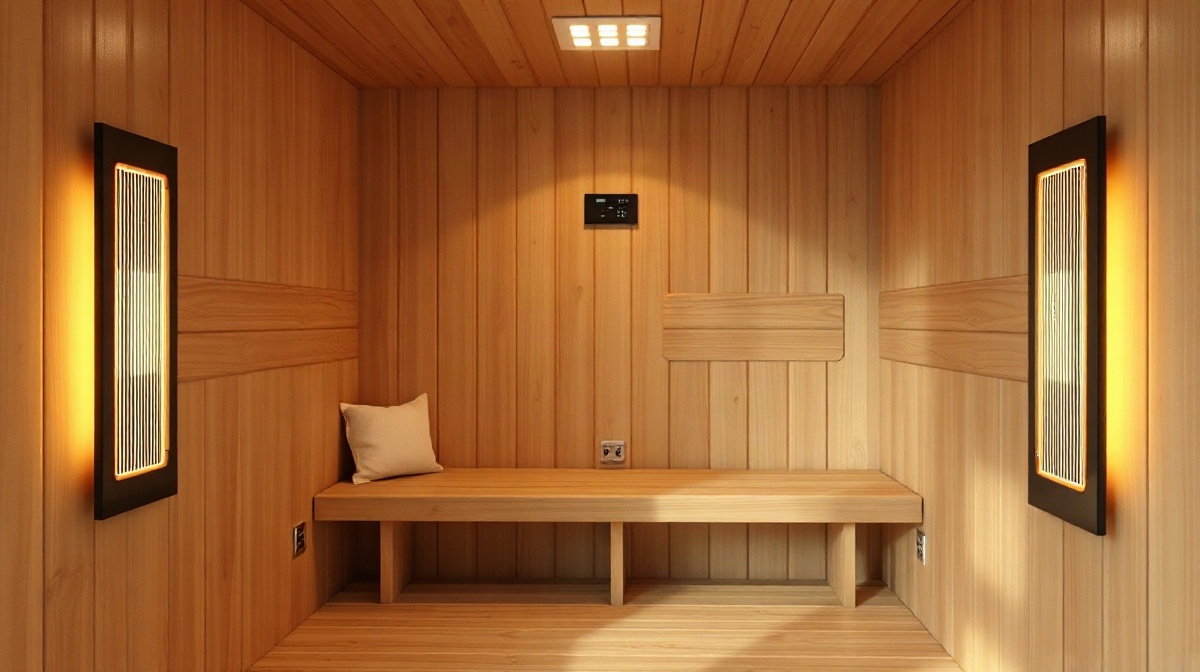
The Barcelona is the most-reviewed sub-$1,500 infrared cabin on Amazon. Eight carbon heating panels, red light therapy emitters included—one of the few cabins at this price that bundles both without an upcharge. Construction is Canadian hemlock. (The manufacturer describes hemlock as a durable hardwood suitable for sauna use; independent comparative testing specific to sauna-grade warping is limited, so treat specific material superiority claims with appropriate skepticism.) Owners consistently report straightforward assembly, typically finishing in one to two hours, and the control panel gets mentioned favorably across reviews.
Pros:
- Best review volume-to-rating ratio in its price tier
- Red light therapy included; hemlock construction; 8 carbon panels for even heat
- Frequently praised assembly process across owner reviews
Cons:
- Two-person capacity is tight for two actual adults
- Carbon panels heat more slowly than ceramic; requires dedicated floor space and a proper outlet
Best for: Serious home recovery users who want a full cabin—with room for a partner on occasion—without crossing $2,000. Not for apartments, and not for anyone without a dedicated outlet and floor space to spare.
Best Two-Person Upgrade: Dynamic Saunas Andora 2-Person Infrared Sauna with Red Light Therapy
4.6★ across 703 reviews | ~$1,799.99 as of October 2026
Skip this section if you’re buying solo. The Andora’s entire value proposition is shoulder room—shared sessions feel genuinely comfortable rather than just technically possible. Same carbon panel and red light therapy combination, same 4.6-star rating, $300 more. Simple as that.
Pros:
- Noticeably roomier than the Barcelona; red light therapy included
- Same 4.6-star rating across a large review pool
Cons:
- $300 premium over the Barcelona for what is, fundamentally, an incremental size increase
- Still requires a dedicated circuit
Best for: Couples who will actually use the sauna together regularly. Not for anyone on a tight budget—the Barcelona is functionally similar for solo use and $300 cheaper.
Best Portable Tent: SereneLife Portable Sauna Box for Home
4.1★ across 2,800 reviews | ~$371.99 as of October 2026
The SereneLife has more reviews than anything else in this roundup by a wide margin—2,800 of them—and that volume is genuinely useful data. At around a quarter of the Barcelona’s price, you get a heated foot pad and folding chair included. Owners consistently describe it as effective for sweating and relaxation. The main recurring complaint is heat retention in cold rooms, which is a documented limitation of fabric-wall construction, not just a few outlier reviews. Worth noting: several one-star reviews specifically mention zipper failure within months of regular use—a failure mode that doesn’t appear in cabin reviews and is worth factoring in if you plan heavy use.
Pros:
- Dramatically lower cost; heated foot pad included; folds flat for storage; enormous review base
- No installation required
Cons:
- Less even heat distribution than a cabin; fabric walls retain less heat; documented zipper durability issues in a subset of owner reviews
Best for: Budget-conscious buyers who want to try infrared heat before committing to a cabin, or anyone who needs a portable option. Not for anyone expecting a spa-grade experience or planning daily use over years.
Best Infrared Blanket: Lifepro RejuvaWrap Infrared Sauna Blanket (Low EMF, 9 Temp Levels)
4.4★ across 1,400 reviews | ~$200 as of October 2026
Nine temperature levels give meaningful control—not just high/low—and the manufacturer prominently publishes a low-EMF specification, which matters for buyers who care about electromagnetic field exposure during longer sessions. Most blankets at this price publish nothing; the RejuvaWrap at least gives you something to verify. Ask for published third-party test documentation, not just the label. Owners consistently describe easy setup and praise heat distribution along the torso. A small subset of reviewers find the enclosed-blanket sensation uncomfortable enough to return it—that’s a real enough pattern across reviews to mention upfront.
Pros:
- Highest rating of the blanket options; nine temperature levels; low-EMF rating specified and published; packs into a bag
Cons:
- Head is not enclosed; less immersive than any cabin; requires a liner or clothing for hygiene; some users find the enclosed sensation claustrophobic
Best for: People who want a truly portable option with closet storage, or those focused on post-workout torso and leg heat. Not for anyone who finds enclosed spaces uncomfortable.
Best for Browsing Multiple Brands: Select Saunas Infrared Sauna Collection
Direct-brand partner pick
Select Saunas is a multi-brand US retailer carrying infrared, traditional, hybrid, barrel, and cabin saunas from Dynamic Saunas, Golden Designs, Maxxus, SaunaLife, HUUM, Almost Heaven, and others. If you want to compare several manufacturers side by side—different wood types, panel configurations, size footprints—before committing to one, their infrared collection is a useful early-research stop. Catalog prices run from around $20 for accessories to $19,000 for premium builds.
A few honest caveats: Select Saunas is a retailer, not a manufacturer, so you’re buying the brands, not Select Saunas-built hardware. If you’ve already identified a specific model, you may find the same unit at a comparable or lower price directly through Amazon or the manufacturer’s site—Select Saunas doesn’t consistently beat the lowest available price, and their catalog’s breadth can make it harder, not easier, to navigate if you already know what you want. Where they genuinely add value is for shoppers who haven’t landed on a brand yet and want curated comparison in one place.
Disclosure: This is a paid partner placement. As with Amazon links on this site, we earn a commission if you buy through our link—it doesn’t affect our editorial assessments.
Browse Select Saunas’ infrared collection →
Best for: Shoppers who haven’t landed on a brand yet and want to compare options before buying. Not for buyers who’ve already decided on a specific model and just need the best price—check Amazon and the manufacturer’s site first.
Safety, Limitations, and Who Should Be Cautious
Cardiovascular conditions: Consult a physician. The cardiac effects documented in the research are real, which means contraindications are also real—this isn’t a generic disclaimer.
Pregnancy: Avoid. Core temperature elevation carries well-documented fetal risks.
Medications: Diuretics, beta-blockers, and certain blood pressure drugs may interact with heat stress. Ask your doctor before starting. People who are careful about medication timing with food or alcohol often don’t think to ask about sauna use—it’s worth raising explicitly with your prescriber.
Alcohol: Never combine with sauna use. Alcohol impairs thermoregulation and significantly raises the risk of heat-related illness.
EMF: Infrared panels emit electromagnetic fields. Units marketed as “low EMF” vary considerably in actual measurements. The International Commission on Non-Ionizing Radiation Protection (ICNIRP) sets general public reference levels for EMF exposure, but no sauna-specific regulatory standard exists. Ask manufacturers for published third-party test results rather than relying on “low EMF” as a self-reported marketing claim—some units back this up with documentation, many don’t.
Before spending anywhere from $200 to $2,000: most of the underlying research involves small samples, short study durations, and specific clinical populations. The evidence for real benefits exists, but it is modest. Single occasional sessions produce less measurable benefit than regular use over weeks, and the strongest effects in the literature come from populations with existing health conditions—not healthy adults using a home unit twice a week. Nothing in this article constitutes medical advice; consult a qualified healthcare provider before beginning any sauna routine, especially if you have an existing health condition.
Frequently asked questions
How long should you stay in an infrared sauna?
Most research protocols and manufacturer guidelines suggest 20–40 minutes per session. If you're new to infrared heat, start at 10–15 minutes at a lower temperature setting and build from there. Staying hydrated before and after is more important than hitting a specific duration target.
Do infrared saunas actually detox your body?
This claim is significantly overstated in marketing. Sweat is primarily water and sodium—it is not a meaningful route for excreting heavy metals or environmental toxins, which the kidneys and liver handle. The relaxation, circulation, and recovery benefits have more credible research support than detoxification claims.
Is it safe to use an infrared sauna every day?
Daily use appears to be tolerated in the clinical studies reviewed—several Japanese FIR studies used daily sessions over multiple weeks. However, this is not a substitute for medical advice. People with heart conditions, those on blood pressure medications, and pregnant individuals should get medical clearance before any sauna routine, daily or otherwise.
What is the difference between near, mid, and far infrared saunas?
Near infrared (NIR, ~700–1400 nm) is promoted for skin and cellular effects. Mid infrared (~1.4–3 µm) is said to penetrate deeper into tissue. Far infrared (FIR, ~3–1000 µm) is the most studied wavelength in published clinical research and is what most home sauna panels emit. 'Full spectrum' units blend all three, but the bulk of the peer-reviewed evidence specifically covers far infrared. Near infrared research, while promising, is considerably thinner at the human clinical level.
Can infrared saunas help with blood pressure?
Research suggests they may, modestly. A study published in the Journal of the American College of Cardiology found that repeated far infrared sauna sessions were associated with improved endothelial function and reduced blood pressure in heart failure patients. These were clinical populations under medical supervision, so results may not translate directly to healthy adults. Anyone on blood pressure medication should consult their physician before starting sauna use, as the cardiovascular effects are real enough to interact with medication dosing. This is not medical advice.
Sources
- Waon therapy for managing chronic heart failure - results from a multicenter prospective randomized WAON-CHF study (Tei et al., Circulation Journal)
- Far-Infrared Sauna as a Novel Complementary Approach in Chronic Heart Failure Patients — Journal of the American College of Cardiology
- Cardiovascular and Other Health Benefits of Sauna Bathing: A Review of the Evidence — Mayo Clinic Proceedings
- Effects of Far-Infrared Sauna Bathing on Recovery from Strength and Endurance Training Sessions in Men (Mero et al.) — Springerplus 2015
- Sauna bathing and systemic inflammation — European Journal of Epidemiology
- Sauna use as a lifestyle practice to extend healthspan — Evidence-Based Complementary and Alternative Medicine
- Infrared Sauna in Patients with Rheumatoid Arthritis and Ankylosing Spondylitis — Clinical Rheumatology
- Do infrared saunas have any health benefits? — Mayo Clinic
- ICNIRP Guidelines on Limiting Exposure to Electromagnetic Fields
- SereneLife Portable Sauna Box — Amazon product listing
- Dynamic Saunas Barcelona 1-2 Person Infrared Sauna — Amazon product listing
- Dynamic Saunas Andora 2-Person Infrared Sauna — Amazon product listing
- Lifepro RejuvaWrap Infrared Sauna Blanket — Amazon product listing