Red Light
Red Light Therapy: Does It Actually Work?
An evidence-based breakdown of what red light therapy can and can't do, grounded in peer-reviewed research, real specs, and honest product picks for home use.
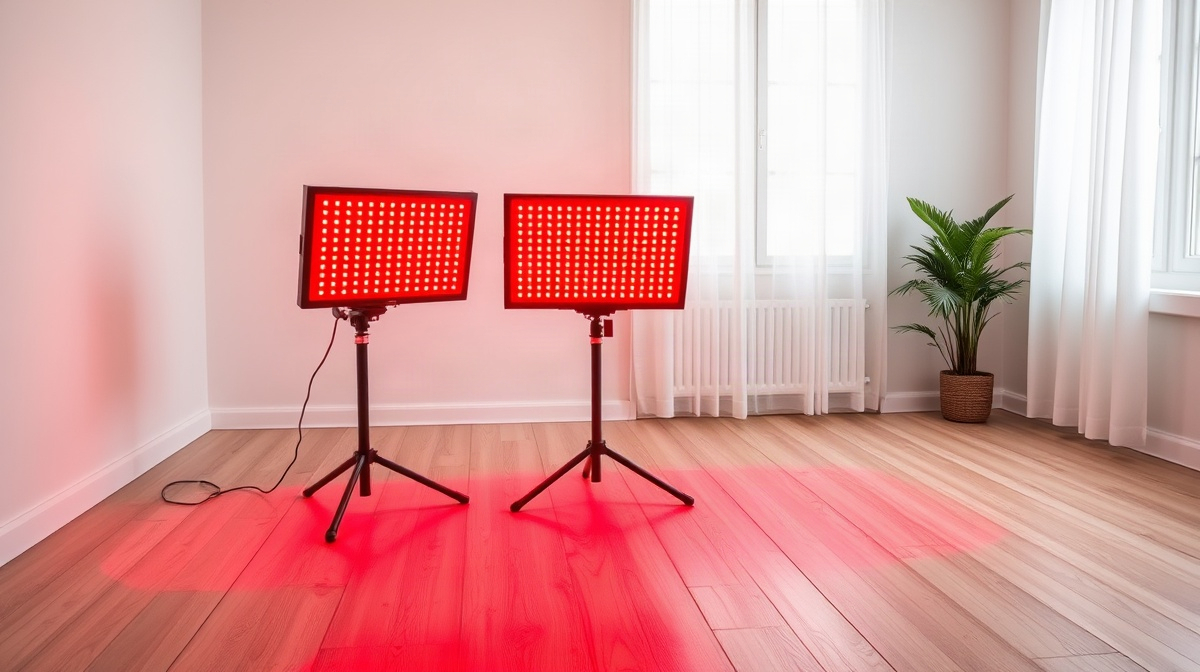
Disclosure We may earn a commission from links on this page, at no extra cost to you — and we only recommend gear we'd stand behind. How this works.
BestQool Red Light Therapy Panel, 660nm Red & 850nm Infrared Light, 105W
Best for Full-body panel coverage at home
The most credible full-panel option in this price tier. If you're going to do red light therapy consistently and seriously, this is the device to start with — bearing in mind that no consumer panel has independently verified irradiance data.
The good
- Highest rating in this category at 4.6★ from 1,800+ reviews
- Dual-wavelength 660 nm and 850 nm coverage
- 105W actual power draw — more verifiable than most
- Wide panel coverage suits multiple body areas per session
The catch
- Highest price on this list at $189 as of July 2025
- Requires wall space and a mounting solution
- Not portable
Comfytemp Red Light Belt with 126 LEDs, 660nm & 850nm, 22W (Corded)
Best for Targeted joint and muscle relief — knees, back, shoulders
Best wrap device on this list. Sensible for targeted sessions on a specific joint or muscle group, not a whole-body solution.
The good
- Highest rating among wrap-style devices at 4.4★
- Dual wavelength in a flexible, wearable format
- Reviewers report secure fit and comfortable warmth
- Affordable entry point for targeted use
The catch
- Corded design limits mobility during sessions
- 22W may not achieve deep-tissue therapeutic dose
- No published irradiance specification
Red Light Therapy for Face and Body, Red Infrared Light Therapy Lamp with Stand, 660nm & 850nm
Best for Easy standalone lamp with the largest review base in this group
The sheer review volume builds confidence. Best for face, neck, or a focused body area rather than broad coverage.
The good
- Most-reviewed product in this category — 3,700+ reviews
- Stand included for simple, adjustable positioning
- Dual wavelength at a mid-range price
- Buyers report reliable performance over months of use
The catch
- Narrower beam than a full panel
- Irradiance not independently verified
- Some buyers note the stand could be sturdier
Red Light Therapy for Body, 660nm 850nm Infrared Light Therapy Pad
Best for Budget-conscious first-timers who want to test the concept
Fine for testing whether red light therapy is for you. Upgrade to the BestQool panel if you stick with it.
The good
- Lowest price on this list
- Nearly 1,900 reviews at a solid 4.2★
- Dual wavelength
The catch
- Build durability more variable per buyer reports
- Limited coverage area
- Best treated as a trial device, not a permanent setup
LED Red Light Therapy Device, 45W, Deep 660nm and Near-Infrared 850nm
Best for Mid-range panel coverage without the BestQool price tag
A reasonable step up from entry-level pads if the BestQool is out of budget. Realistic about its limitations.
The good
- More coverage area than lamps or wraps
- Dual wavelength
- 1,600+ reviews at 4.3★
- Approachable price point
The catch
- Less than half the wattage of the BestQool
- Spec sheet less detailed
- Longer sessions may be needed to achieve therapeutic dose
Red light therapy has real, peer-reviewed research behind it. It also isn’t a cure-all — consumer marketing routinely outpaces the evidence by enough to cost you real money on the wrong device. What follows is what the research actually shows, where it goes quiet, and how to pick hardware worth buying.
What Is Red Light Therapy, Exactly?
Red light therapy — also called photobiomodulation (PBM) or low-level laser/light therapy (LLLT) — uses specific wavelengths of red and near-infrared (NIR) light to penetrate tissue and trigger cellular responses. The two wavelengths cited most often are 660 nm (red, skin-surface level) and 850 nm (near-infrared, deeper tissue). Some devices add a 940 nm chip as a third option.
The proposed mechanism is well-documented in cell biology. Light in this range is absorbed by cytochrome c oxidase — a photoreceptor in the mitochondria — which research suggests stimulates ATP production, essentially giving cells more energy. A 2017 review in Photobiomodulation, Photomedicine, and Laser Surgery describes this pathway in detail and notes it is one of the more mechanistically established aspects of the field.
Does Red Light Therapy Actually Work?
For certain applications: research suggests yes. For others, the evidence is thin. Some claims have multiple randomized controlled trials behind them. Others rest on small pilot studies or animal models. What you’re trying to treat matters enormously — there is no single answer that covers the whole field.
Skin health and collagen
A 2014 study in Photomedicine and Laser Surgery is one of the more rigorous entries in this space. Participants using 633 nm and 830 nm light showed significant improvements in skin complexion, tone, and collagen density compared to placebo controls — measured via profilometry and histology, not self-report. A 2023 systematic review in the Journal of Cosmetic Dermatology reinforced findings on wrinkle reduction, noting that consistent, adequate-dose protocols produced measurable changes in dermal collagen.
The keyword there is consistent. Most positive trials ran 8–12 weeks of multiple weekly sessions.
Muscle recovery and exercise performance
A 2016 systematic review in Lasers in Medical Science examined data across multiple studies and found that PBM application was associated with reduced muscle fatigue and post-exercise soreness versus control conditions. Effects were modest but statistically significant across multiple independent studies. Athletes and active-recovery communities have driven most of the consumer demand here, and the science at least partially holds up — though it should be read as research suggesting benefit, not a guaranteed outcome.
Joint pain and inflammation
The evidence here is real but limited. A Cochrane systematic review (Brosseau et al., Cochrane Database of Systematic Reviews, CD002049.pub2) found low-to-moderate evidence that LLLT reduced pain and morning stiffness in rheumatoid arthritis, though trial quality varied considerably. For general joint soreness and muscle inflammation the picture is more encouraging — but calling this a treatment for arthritis would be an overreach. Research suggests a reduction in inflammatory markers. It does not establish red light as a medical treatment, and nothing in this article should be taken as medical advice.
Hair growth
A 2013 RCT in Lasers in Surgery and Medicine (PMID 23701084) found that men with androgenetic alopecia using a 655 nm laser device showed significantly increased hair density versus sham controls at 26 weeks. The FDA has cleared certain low-level laser devices for hair growth as a cosmetic device — not a drug. That’s a meaningful, if limited, regulatory distinction.
What it probably doesn’t do
Red light therapy does not regenerate joints, reverse severe skin damage, or replicate medical procedures. Claims extending into those territories have no current evidentiary support.
The Variables That Determine Whether It Works
Consumer disappointment with red light therapy mostly traces back to dosing. Research showing positive outcomes used specific doses — measured in joules per square centimeter (J/cm²) — delivered at specific power densities (mW/cm²). Published trials have used a wide range of therapeutic power densities depending on target tissue and indication. A 2020 paper in Photobiomodulation, Photomedicine, and Laser Surgery specifically flags underdosing as the most common failure mode in consumer PBM. Devices that look impressive often don’t deliver enough energy per unit area to trigger a meaningful cellular response.
Most consumer products don’t publish irradiance data in any verifiable way. Irradiance drops with the square of the distance from the source — which means a panel rated at 105W actual draw at 6–12 inches is operating in a more plausible range for clinically relevant output than a 22W device at the same distance. Neither figure is independently verified in this product category. That’s the honest state of the market.
Key variables:
- Wavelength: 660 nm for skin-surface effects; 850 nm for deeper tissue. Both matter for most applications.
- Power density: Too low and you won’t reach therapeutic thresholds. Too high risks photothermal damage — rare at consumer levels, but possible.
- Distance from skin: Irradiance drops sharply with distance. Most panel manufacturers specify a treatment distance. Use it.
- Session duration and frequency: Most positive trials used 10–20 minute sessions, multiple times per week, over weeks to months.
Home Devices: What to Actually Buy
Five products are reviewed below, selected for review volume, rating stability, and the degree to which their published specs are actually checkable. Prices are from Amazon listings as of July 2025 and are subject to change. No brand in this category publishes independently third-party-verified irradiance data — that’s a limitation of the entire consumer market, not a knock on any single product.
A word on the BestQool at the top of this list. Its ranking rests on Amazon review data and listed specs — not a third-party irradiance test or photonics lab measurement. That’s a real gap, and it’s worth naming plainly. What BestQool has going for it: a wattage claim that appears on the label and in the product specs, making it at least auditable; and a 4.6-star average across more than 1,800 reviews, which is a large and stable signal in a category where most products plateau well under 1,000 ratings. It is the most credible available option in this price tier. That is not the same as independently verified, and the two should not be conflated. Buyers trying to match a precise clinical dosing protocol should know the data simply isn’t there yet — for this device or any consumer panel.
BestQool Red Light Therapy Panel, 105W — Best Full-Body Panel
4.6★ | 1,800+ reviews | ~$189 as of November 2026
At 105W with 660 nm and 850 nm LEDs, the spec sheet lists enough output to cover a meaningful treatment area at appropriate distance. The 105W actual draw appears on the label and in the product listing — which makes it more auditable than most competitors whose wattage figures are buried or unspecified. At this wattage, reaching a clinically relevant irradiance level at a reasonable treatment distance (roughly 6–12 inches) is physically more plausible than it is for lower-wattage devices; however, no published measurements independently confirm it. Owner reviews tracking use over 8–12 weeks are predominantly positive, which tracks with the clinical timelines in published trials.
BestQool is a China-based brand sold primarily through Amazon. Manufacturing provenance isn’t detailed in the listing — that’s standard for this category. Third-party irradiance verification isn’t available, and that matters if you’re trying to match a clinical protocol precisely.
Pros: High review volume and rating; dual-wavelength; full-panel coverage; wattage more transparent than most.
Cons: $189 as of November 2026 is a real commitment. It needs wall space and a mounting solution, and it’s going nowhere — this is not a device you toss in a bag.
Anyone expecting a few sessions to produce visible results should reconsider. This device rewards patience and routine. Without both, it’s expensive wall decor.
Comfytemp Red Light Belt, 126 LEDs (660 nm & 850 nm), 22W — Best Wrap for Targeted Use
4.4★ | 1,500+ reviews | ~$37.99 as of November 2026
The highest-rated flexible wrap in this group. 126 LEDs across both wavelengths, corded design, consistent power output — sensible for knees, lower back, or shoulders. Corded is a genuine trade-off: you’re not moving around during a session. But it also means the power output doesn’t drift the way battery-powered alternatives can. Multiple reviewers flag the fit as more secure than similar wraps they’d tried previously.
At 22W the draw is modest, appropriate for a contact device sitting directly against skin. Deep-tissue applications are probably asking too much of it. The 2020 Photobiomodulation paper’s point about underdosing applies here directly — the 22W input is stated, but output at skin surface is not, which is an honest limitation buyers should factor in.
Pros: Top rating among wrap-style devices; dual wavelength; comfortable per reviewer reports; affordable.
Cons: Corded limits mobility during use. At 22W, don’t expect it to reach deep muscle tissue.
Red Light Therapy Lamp with Stand, 660 nm & 850 nm — Best Standalone Lamp
4.3★ | 3,700+ reviews | ~$67.99 as of November 2026
Here’s what actually earns this lamp its spot: 3,700+ ratings is more than double any other product on this list. At that volume, a 4.3-star average stops being a rounding artifact. The stand makes positioning straightforward and adjustable. Dual-wavelength output covers the bases most people care about.
Coverage is the real trade-off. This is a focused lamp, not a panel. Each session treats a limited area, so running a back-and-shoulders routine in one pass isn’t realistic. Face and neck, single joints, targeted spots — that’s the right use case for it, and it handles that use case well.
Pros: Largest review base in this category by a wide margin; stand included; dual wavelength; mid-range price.
Cons: Narrower beam than a full panel; irradiance not independently verified; some buyers note the stand is less stable than expected.
Who should skip it: Anyone hoping to treat large body areas in a single session. It’s a face-and-neck or single-joint device, not a full-back solution.
Red Light Therapy Pad, 660 nm & 850 nm — Best Budget Flat Pad
4.2★ | 1,900+ reviews | ~$28.04 as of November 2026
The lowest barrier to entry on this list. At $28.04 as of November 2026, it’s a reasonable way to find out whether red light therapy actually fits your routine before spending real money — and “trial device” is genuinely the right frame for it. Buyer feedback is positive overall, but durability complaints run more frequent here than in the Comfytemp’s review set. A handful of users report fraying or connection issues after a few months of regular use.
If you use this consistently for 8–12 weeks and find yourself wanting more, the BestQool panel is the natural upgrade. If the habit doesn’t stick, you haven’t lost much.
Pros: Lowest price; nearly 1,900 reviews at 4.2★; dual wavelength.
Cons: Build quality more variable per buyer reports; limited coverage area; lowest wattage on the list.
LED Red Light Therapy Panel, 45W (660 nm & 850 nm) — Mid-Range Panel
4.3★ | 1,600+ reviews | ~$54.99 as of November 2026
This one lands between the entry-level pads and the BestQool on every axis — price, coverage, wattage. At 45W it covers more area per session than a lamp or wrap, and the price is approachable. The limitation is dose delivery: reaching clinically relevant irradiance at the recommended treatment distance may require sessions on the longer end of the range. The spec sheet is also less detailed than the BestQool’s, which makes it harder to audit.
Still a reasonable choice if the BestQool is out of budget and you want more coverage than a lamp or pad can offer.
Pros: Better coverage than lamps or wraps; dual wavelength; solid review base; competitive price.
Cons: Less than half the wattage of the BestQool; thinner spec documentation; brand has a shorter track record.
Who should skip it: Anyone who wants maximum coverage or the highest available confidence in dose delivery. Save up for the BestQool.
Safety Considerations
The main documented risk at consumer wavelengths and power levels is eye exposure. Looking directly into high-intensity LEDs can cause retinal damage. Use the included goggles or rated safety glasses — every session, no exceptions.
Beyond that: clinical PBM literature and regulatory guidance on photobiomodulation devices consistently identify several groups who should consult a physician before using these devices. Those with photosensitizing medical conditions, people taking medications that increase light sensitivity, and pregnant individuals (specifically regarding abdominal exposure) are flagged across multiple clinical sources. These aren’t obscure edge cases; they appear in published PBM clinical guidelines. Nothing in this article constitutes medical advice. When in doubt, consult a physician.
Frequently asked questions
How long does red light therapy take to work?
Most peer-reviewed trials that showed positive results ran 8–12 weeks of consistent use, with sessions typically 10–20 minutes several times per week. Single sessions may produce short-term effects, but structural changes — collagen remodeling, for example — take sustained protocols. Expecting results in a week or two sets you up for disappointment.
What wavelength of red light therapy is most effective?
It depends on the application. Research on skin health and surface-level collagen production most often uses 630–660 nm. Deeper tissue applications — muscle recovery, joint inflammation — tend to use 800–850 nm near-infrared. Most consumer devices now combine both, which is a reasonable approach given the different penetration depths. Neither wavelength is universally 'better'; they address different tissue depths.
Can red light therapy be harmful?
At consumer power levels and appropriate distances, serious harm is uncommon. The main documented risk is eye injury from direct LED exposure; always use rated safety goggles. People with photosensitizing conditions or medications, those who are pregnant, and individuals with active skin cancer should consult a physician before use. These are standard contraindications cited in clinical PBM literature. Nothing here constitutes medical advice.
Is red light therapy at home as effective as in a clinic?
Clinical devices typically have higher, verified irradiance output and trained practitioners who can optimize dosing. Home devices vary widely, and many consumer products don't publish irradiance data in a verifiable way. That said, research suggests that consistent home use with a properly powered device may produce meaningful results for skin and recovery applications. The gap narrows when you use a higher-wattage panel at the correct distance and with consistent frequency — but home and clinical devices should not be assumed equivalent.
How often should you use red light therapy?
Most protocols studied in published trials involve 3–5 sessions per week. Daily use is not contraindicated at consumer power levels, but the evidence base is built mostly on every-other-day or three-times-weekly schedules. Consistency over weeks matters more than any single session's duration. Rest days between sessions may allow cellular responses to fully develop, though the research on optimal frequency is still evolving.
Sources
- Photobiomodulation: The Clinical Applications of Low-Level Light Therapy — Photobiomodulation, Photomedicine, and Laser Surgery (2017)
- A Controlled Trial to Determine the Efficacy of Red and Near-Infrared Light Treatment in Patient Satisfaction, Reduction of Fine Lines, Wrinkles, Skin Roughness, and Intradermal Collagen Density Increase — Photomedicine and Laser Surgery (2014)
- Effects of Low-Level Laser Therapy on Skeletal Muscle Repair: A Systematic Review — Lasers in Medical Science (2016)
- Low Level Laser Therapy for Rheumatoid Arthritis (Cochrane Review, CD002049.pub2) — Cochrane Database of Systematic Reviews
- A Randomized, Double-Blind Clinical Trial on the Efficacy of Low-Level Laser Therapy for Androgenetic Alopecia — Lasers in Surgery and Medicine (2013)
- Dosing Considerations for Photobiomodulation Therapy in Home Use Devices — Photobiomodulation, Photomedicine, and Laser Surgery (2020)
- Red Light Therapy for Skin Rejuvenation: Systematic Review — Journal of Cosmetic Dermatology (2023)
- BestQool Red Light Therapy Panel B07ZCDDLDN — Amazon Product Listing — Amazon.com
- Comfytemp Red Light Belt B0D6GHY88X — Amazon Product Listing — Amazon.com
- Red Light Therapy Lamp with Stand B0CHDHBDQJ — Amazon Product Listing — Amazon.com
- Red Light Therapy Pad B0C8NR1NVS — Amazon Product Listing — Amazon.com
- LED Red Light Therapy Panel B09PYBQF56 — Amazon Product Listing — Amazon.com