Guides
Sauna & Cold Plunge Contrast Therapy: A Practical Guide
How to structure a sauna and cold plunge contrast therapy session at home — order, timing, safety rules, and gear recommendations from the Stoke & Soak editorial team.
Disclosure We may earn a commission from links on this page, at no extra cost to you — and we only recommend gear we'd stand behind. How this works.
Durasage Portable Steam Sauna for Home
Best for First-timers wanting low financial risk
Best budget starting point for contrast therapy. Don't overthink it at this price.
The good
- Lowest cost of entry among well-reviewed steam saunas
- 800W generator heats quickly
- 60-minute timer with foldable design for easy storage
- Over 3,300 ratings — largest review base in this category
The catch
- Seated-only format limits full-body heat exposure
- Gets uncomfortable for sessions beyond 30–40 minutes
- Steam format produces a different heat stimulus than infrared or traditional sauna
Durasage Oversized Portable Personal Steam Sauna Spa
Best for Taller users or anyone who found standard steam tents too cramped
The better buy over the base Durasage if you're over 5'10" or value the extra interior room.
The good
- Highest rating (4.4★) in the steam tent category
- Oversized collar reduces steam leakage
- Dual pockets and zippered hand openings add usability
- Only $10 more than the base Durasage model
The catch
- Larger footprint takes more storage space
- Same 800W generator as base model — no heating upgrade
Manastin 2 Person Portable Steam Sauna for Home
Best for Couples or partners doing contrast sessions together
The obvious pick if two people will be using it. Solo users should stick with the Durasage Oversized.
The good
- Genuine two-person capacity with dual foldable chairs
- 9 heat levels via remote control
- 4.4★ rating across 515 reviews — strong for a newer listing
The catch
- Solo users pay a premium for capacity they won't use
- Newer to market, so long-term durability data is thinner
SereneLife Portable Steam Sauna Tent with Extra Large 4L Steamer
Best for Taller users who need extra height in a steam tent format
Functional, but the rating and price combo puts it third in line behind the two Durasage models for most buyers.
The good
- Extra-large 4L steam reservoir
- 5'9" interior height — tallest in the steam tent segment
- Remote control with 9 heat levels
- 3,100+ reviews provides solid reliability signal
The catch
- Larger reservoir means longer initial heat-up time between rounds
- 4.1★ is the lowest rating in this group
- Costs more than the better-rated Durasage units
DYNAMIC SAUNAS Elite 1-Person Infrared Sauna with Red Light Therapy
Best for Dedicated home recovery rooms with permanent floor space and budget
The best-reviewed home sauna on this list, full stop. Worth the cost if you're building a permanent recovery space. Not the right call for renters or anyone without a dedicated room.
The good
- Best rating of any unit on this list at 4.6★
- Cabin-style FAR infrared with low EMF rating
- Pacific Cedar construction — durable and naturally antimicrobial
- Includes red light therapy and Bluetooth audio
- Infrared sauna benefits reviewed in Mayo Clinic Proceedings (Laukkanen et al., 2018)
The catch
- Requires dedicated floor space — not foldable
- Assembly required; owners report 1–2 hours setup
- Lower ambient temps than traditional sauna may require protocol adjustment
- Red light therapy evidence is thinner than heat evidence — don't buy for that feature alone
Heat first, cold second, repeated. Where people actually get lost is the specifics: how long each phase should run, when the research supports stopping versus pushing, and how to build this at home without spending five figures on equipment that might collect dust.
What Is Contrast Therapy, and What Does the Research Actually Say?
Contrast therapy means deliberately alternating between heat exposure and cold immersion. When you step from a 170°F sauna into 50°F water, your blood vessels swing hard in opposite directions — dilating in heat, clamping down in cold. Researchers studying this effect have proposed that the repeated vasodilation-vasoconstriction cycle may act like a pump, pushing metabolite-laden blood out of fatigued muscles, and have associated it with improved circulation and faster clearance of metabolic byproducts from muscle tissue.
The research is real, but the quality is uneven. A 2022 systematic review and meta-analysis in the European Journal of Applied Physiology (Springer, DOI: 10.1007/s00421-022-04919-4) found that contrast water therapy reduced delayed-onset muscle soreness more effectively than passive recovery alone. Separate meta-analytic work on cold-water immersion, published in the British Journal of Sports Medicine (2012, vol. 46, no. 4), found reductions in perceived post-exercise fatigue — but effect sizes varied considerably across populations. The AMA’s public health resource on cold plunges and contrast therapy (“4 Things to Know About Cold Plunges and Contrast Therapy,” ama-assn.org) notes that participants report improvements in mental health and muscle recovery — self-reported outcome data, not a controlled trial result.
On the heat side, a 2018 review in Mayo Clinic Proceedings (Laukkanen et al., S0025-6196(18)30275-1) examined cardiovascular and other health benefits of sauna bathing; much of the underlying cohort research used traditional Finnish saunas at approximately 174°F. Infrared saunas run considerably cooler — typically 120–140°F versus 150–195°F for traditional — which affects the heat stimulus meaningfully. Protocol numbers drawn from Finnish sauna research don’t transfer directly to infrared use without adjustment.
None of the above should be read as medical advice. Anyone with cardiovascular conditions, pregnancy, or blood pressure disorders should consult a physician before starting.
What Order Should You Do Sauna and Cold Plunge?
Always heat first, cold second. Heat prepares the body — core temperature climbs, peripheral circulation opens up, muscles loosen. Going cold-to-heat isn’t dangerous for healthy adults, but it blunts the vascular contrast effect that is the whole point of doing this.
A typical structure:
Round 1: 10–20 minutes of heat → 1–3 minutes of cold → 5 minutes rest Round 2: 10–15 minutes of heat → 1–3 minutes of cold → 5 minutes rest Round 3 (optional): 10 minutes of heat → 1–3 minutes of cold
Two to three rounds. Beginners: do two, not three.
End cold or warm? For post-exercise recovery, ending cold is how most post-exercise cold-immersion research protocols are structured — the rationale being that cold immersion at the end keeps the anti-inflammatory and analgesic effects from being immediately reversed by a return to heat. For general relaxation, ending warm is common practice and leaves the nervous system in a calmer state. If you’re pairing contrast therapy with training, finishing cold is the defensible call.
How Long Should Each Phase Be?
Sauna phases: 10–20 minutes. Cold phases: 1–3 minutes. Here’s why those ranges exist, and why they’re not interchangeable.
The Finnish sauna research underlying most of the long-term health outcome data used sessions of roughly 15–20 minutes at approximately 174°F. Portable steam saunas and infrared units run cooler and may need longer exposures to produce equivalent core temperature increases — but no peer-reviewed comparison between formats has pinned down an exact conversion factor. Monitor your response closely in the first few sessions, especially if you’re switching from one format to another.
For cold immersion, research on post-exercise cold-water immersion — including the 2012 British Journal of Sports Medicine meta-analysis — typically examines temperatures of 50–59°F (10–15°C) for durations ranging from 1–15 minutes. Shorter durations at colder temperatures appear to produce broadly similar physiological responses to longer durations at warmer ones, though the evidence base for exact equivalencies is limited. Community data from r/sauna and r/coldplunge shows experienced practitioners settling at 2–4 minutes in the 40–50°F range, though that reflects self-reported patterns from a large, self-selected group rather than any clinical protocol.
One hard rule: don’t push cold immersion past the point where you can’t control your breathing. The cold shock response — involuntary gasping, hyperventilation — peaks in the first 30 seconds and usually subsides. If controlled breathing hasn’t returned within a minute, get out. Not in two minutes. Out.
How to Build a Contrast Setup at Home
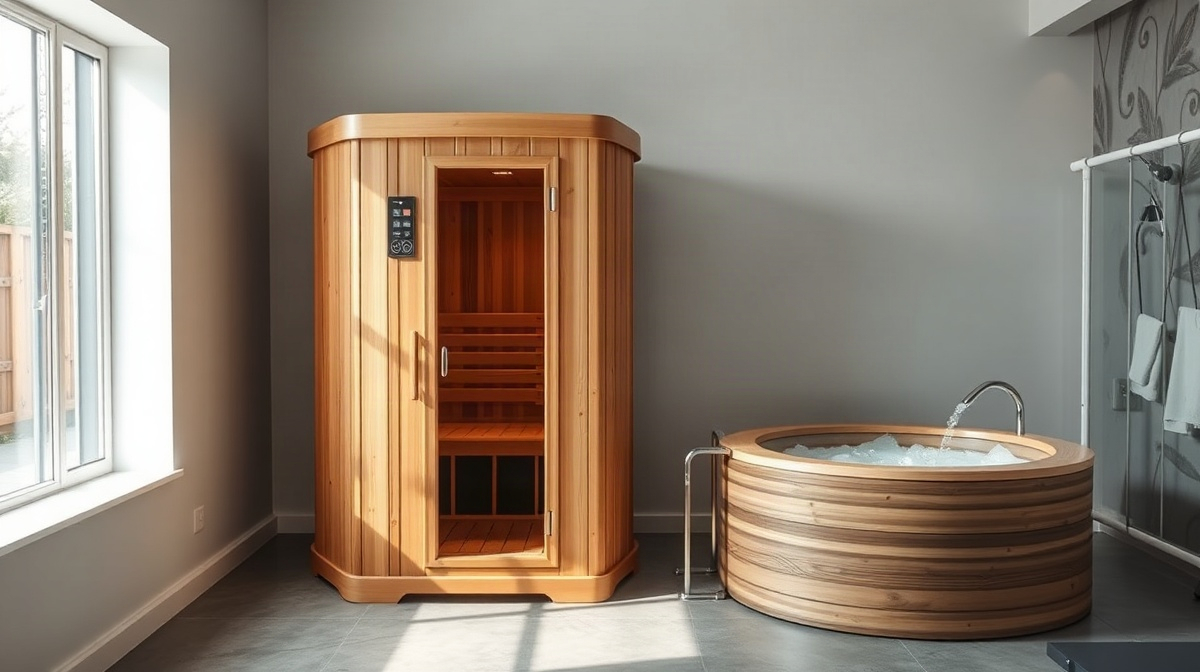
A full commercial contrast therapy suite — barrel sauna, chilled plunge tank, proper drainage — runs $5,000–$15,000+ installed. For home use, the realistic options are portable steam saunas or compact infrared cabins paired with a chest freezer conversion, a stock tank, or a purpose-built cold plunge tub.
The home sauna market has solid mid-range options at most price points. The cold plunge side is narrower — there are a handful of purpose-built tubs with active chilling, but most are expensive, and pricing moves enough that any specific number here would be stale within a few months. What’s available on Amazon right now skews heavily toward the portable steam tent format at the budget end and one-person infrared cabins at the step-up tier. Mid-range users who want more than a tent but can’t absorb a $1,500 hit don’t have many purpose-built options.
Prices, ratings, and review counts below were pulled from Amazon listings as of July 2025 and fluctuate — verify before buying.
Portable Steam Saunas (Budget–Mid Range)
Durasage Portable Steam Sauna (B08P53QBPJ) — $109.95 as of July 2025 The highest-volume entry on this list, with over 3,300 ratings at 4.3 stars. The 800W steam generator and 60-minute timer are functional specs for the price. Owners consistently report it heats quickly, and the folding design stores flat. The seated-only format limits full-body heat exposure compared to standing infrared units — a real trade-off worth knowing before you buy.
Best for: First-timers who want low financial risk before committing to anything larger. Not for: Anyone planning sessions longer than 30–40 minutes or taller than average — the seated tent format gets uncomfortable fast.
Durasage Oversized Portable Steam Sauna (B08141NYWV) — $119.95 as of July 2025 A step up in interior space (33″×31.5″×41″ versus the standard model), same 800W generator, with dual pockets and zippered hand openings. At 4.4 stars across 1,300+ reviews, it edges slightly higher in satisfaction than the base model. Owners note the oversized collar reduces steam leakage around the neck — less heat escaping means more consistent session temperature, which matters if you’re targeting 15-minute holds.
Best for: Taller users, or anyone who found standard steam tents too cramped.
Manastin 2-Person Portable Steam Sauna (B0DK19S3PW) — $129.99 as of July 2025 Dual foldable chairs, 9 heat levels via remote, 4.4 stars across 515 reviews. Newer to market, so long-term durability data is thin. Straightforward pick if two people will actually use it. Solo users: the Durasage Oversized is $10 cheaper and a better fit — you’re paying for a second seat that does nothing for you.
SereneLife Portable Steam Sauna Tent (B084GY5CHB) — $139.98 as of July 2025 Extra-large 4L steamer, remote control with 9 heat levels, one of the tallest profiles in the format at 5′9″ interior height. Rated 4.1 stars across 3,100+ reviews — solid review volume, but satisfaction runs noticeably lower than the Durasage units. The larger steam reservoir also extends reheat time between rounds, which can disrupt the rhythm of a timed protocol. At $140 with a lower satisfaction rating than options that cost $20 less, the case for choosing it over the Durasage models is weak.
Best for: Taller users who specifically need the extra height and want steam over infrared.
Infrared Saunas (Step-Up)
Dynamic Saunas Elite 1-Person Infrared (B0FLWMT968) — $1,499.99 as of July 2025 A cabin-style FAR infrared sauna in Pacific Cedar, with low-EMF panels, red light therapy, and Bluetooth audio. At 4.6 stars across 700+ reviews, it’s the best-rated unit on this list by a meaningful margin. FAR infrared operates at lower ambient temps — typically 120–140°F — but still produces significant core heating through radiant energy rather than convection. The 2018 review in Mayo Clinic Proceedings (Laukkanen et al., S0025-6196(18)30275-1) covers cardiovascular and other health benefits associated with sauna bathing broadly, and includes infrared format context.
The red light therapy panel is a real inclusion, but the evidence supporting red light therapy specifically is thinner and more contested than the evidence for heat. Research suggests sauna heat is where the more documented benefits sit; the red light is a secondary feature and isn’t worth factoring heavily into a $1,500 purchase decision.
Best for: Dedicated home recovery rooms with permanent floor space and a real budget for this. Not for: Renters, anyone in a small apartment, or anyone not prepared to commit to 1–2 hours of assembly and a fixed footprint.
Safety: What Actually Matters
Hydrate before, not just after. Research on sauna use — including the Laukkanen cohort work published in Mayo Clinic Proceedings — documents meaningful fluid losses per session and identifies dehydration as a primary avoidable risk. Start hydrated. Keep water within reach during rest periods. Dehydration builds gradually; you often don’t register it until it’s already affecting your judgment.
Never combine alcohol with contrast therapy. The AMA’s public health resource on cold plunges and contrast therapy (ama-assn.org) notes that alcohol impairs thermoregulation and is contraindicated alongside sauna and cold-water immersion.
Know what presyncope feels like. Lightheadedness and narrowing vision during the heat phase indicate falling blood pressure — the clinical term is presyncope. If it starts, exit immediately, sit or lie down, and don’t try to push through. It can arrive faster than people expect, particularly in the first few sessions.
Cold shock is real. Entering cold water too quickly triggers involuntary gasping and can pose cardiac stress in susceptible individuals. Enter slowly. Beginners should not cold plunge alone — the risk of a cold shock response that impairs your ability to self-rescue is genuine, not theoretical.
Children, pregnant individuals, and those with cardiac or blood pressure conditions should not attempt contrast therapy without physician clearance. The Banner Health clinical team describes contrast therapy as “real physical stress on the body” (bannerhealth.com, “Comparing Cold Plunges and Infrared Saunas”) — and that applies before you ever feel like you’re overdoing it. This guide is not medical advice.
The Cold Side of the Setup
This guide focuses on sauna products because that’s where home market options are most stable and product selection is clearest. On the cold side, purpose-built plunge tubs from brands like Ice Barrel, Plunge, and Nordic Wave span a wide price range depending on chilling capacity — check current manufacturer pricing, since that segment moves fast.
The entry-level DIY option is a stock tank from a farm supply store filled with ice. The tank costs under $100. It works. Get a basic aquarium thermometer before your first session — available at most pet supply stores — so you actually know whether you’ve hit the 50–59°F (10–15°C) range that covers most published cold-water immersion research. Guessing from ice quantity is not a reliable method.
Frequently asked questions
Should you end a contrast therapy session with heat or cold?
For post-exercise muscle recovery, ending cold is how most post-exercise cold-immersion research protocols are structured — the rationale being that cold immersion keeps the anti-inflammatory and analgesic effects from being immediately reversed by a return to heat. For general relaxation or stress relief, ending with heat is common practice and leaves the body in a calmer state. Match the finish to your goal.
How many rounds of sauna and cold plunge should you do?
Two to three rounds is the most commonly used structure in both research protocols and practitioner guidance. A round is one heat phase plus one cold phase. More rounds are not automatically more beneficial, and beginners should start with two. Adding a third round only makes sense once the first two feel controlled and manageable.
Is contrast therapy safe for everyone?
No. People with cardiovascular disease, high blood pressure, a history of fainting, or who are pregnant should not attempt contrast therapy without physician clearance. The Banner Health clinical team describes it as 'real physical stress on the body' — an accurate framing. This content is not medical advice; consult a physician if you have any relevant health conditions.
What temperature should the cold plunge be for contrast therapy?
Most published research on cold-water immersion — including the 2012 British Journal of Sports Medicine meta-analysis — uses temperatures of 50–59°F (10–15°C). Water colder than 50°F should mean shorter immersion times, and anything approaching freezing significantly raises the risk of cold shock. A basic aquarium or brewing thermometer lets you verify temperature rather than guessing from ice quantity.
Does a portable steam sauna work for contrast therapy, or do you need a traditional sauna?
Portable steam saunas can work for contrast therapy, especially for beginners. They run at lower temperatures than traditional Finnish saunas and rely on steam humidity rather than dry convective heat — which changes the experience and may reduce the intensity of the heat stimulus. They are a much more affordable starting point, but the physiological response will differ from a traditional or infrared cabin. Adjust session length accordingly and monitor how your body responds.
Sources
- 4 things to know about cold plunges and contrast therapy — American Medical Association
- Comparing Cold Plunges and Infrared Saunas — Banner Health
- Contrast water therapy and exercise induced muscle damage: a systematic review and meta-analysis (DOI: 10.1007/s00421-022-04919-4) — European Journal of Applied Physiology
- Cardiovascular and Other Health Benefits of Sauna Bathing: A Review of the Evidence (Laukkanen et al., S0025-6196(18)30275-1) — Mayo Clinic Proceedings
- Cold-Water Immersion and Recovery From Strenuous Exercise: A Meta-Analysis (BJSM 2012, vol. 46, no. 4) — British Journal of Sports Medicine
- Durasage Portable Steam Sauna B08P53QBPJ — Product Listing — Amazon
- Durasage Oversized Portable Steam Sauna B08141NYWV — Product Listing — Amazon
- Manastin 2 Person Portable Steam Sauna B0DK19S3PW — Product Listing — Amazon
- SereneLife Portable Steam Sauna Tent B084GY5CHB — Product Listing — Amazon
- DYNAMIC SAUNAS Elite 1-Person Infrared Sauna B0FLWMT968 — Product Listing — Amazon