Saunas
Best Sauna Heaters: Electric, Wood & Infrared
Compare the best home sauna heaters by type—electric, wood-burning, and infrared—with real specs, wattage guidance, and honest pros and cons for each.
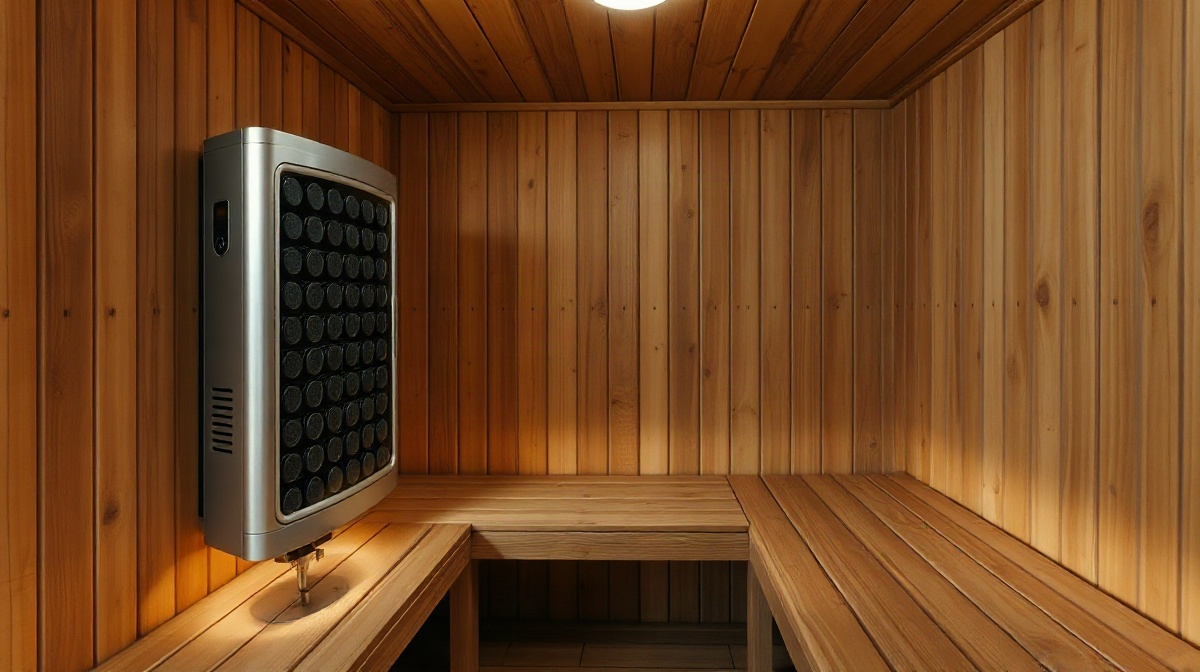
Disclosure We may earn a commission from links on this page, at no extra cost to you — and we only recommend gear we'd stand behind. How this works.
VEVOR 6KW Electric Sauna Stove (220V)
Best for Budget home builders with a small-to-medium sauna room
The best value electric heater on Amazon for a first home sauna build. Expect to spend a little extra on better stones and don't skip the electrician.
The good
- Covers rooms up to 318 cu ft per spec sheet
- Built-in 3-hour timer and adjustable temperature control
- Dramatically cheaper than name-brand Finnish heaters
- Owners report reliable heat-up in small rooms
The catch
- Entry-level steel gauge—not Harvia or HUUM build quality
- Included stones are lightweight; most owners upgrade them
- Requires 220V/30A dedicated circuit and licensed electrician
Dynamic Saunas Barcelona 1-2 Person Infrared Sauna with Red Light Therapy
Best for Renters or apartment dwellers who want infrared without any electrical work
The best all-in-one infrared option on this list—but be clear on what you're buying. It's not a traditional sauna.
The good
- 110V plug-in—no electrician, no permit in most areas
- Includes red light therapy panels
- 4.6 stars across 778 Amazon reviews at time of writing
- ~20-minute assembly; compact footprint
The catch
- No steam, no stone, no traditional Finnish experience
- Lower operating temp—not a replacement for a traditional sauna
- High price for an infrared cabin kit
Albott 1 Person Infrared Sauna, Low EMF 110V
Best for Solo users wanting a low-EMF infrared cabin at a lower price point
A solid solo infrared cabin for the price. Review volume is lower than the Barcelona, so weigh that accordingly.
The good
- 110V plug-in, no special wiring needed
- Low-EMF stated by manufacturer for buyers who prioritize that spec
- 4.4 stars; positive owner feedback on compact size
The catch
- Smaller owner review sample (119 reviews) than competitors
- Tight 1-person fit—not suitable for taller users
- Low-EMF claim is manufacturer-stated, not independently certified
X-Vcak Upgraded Portable Sauna with Steamer and Remote Control
Best for Renters, travelers, or anyone wanting no-commitment steam
Best for occasional use and zero commitment. Don't confuse it with a real sauna heater—it's a convenience product.
The good
- 1,600+ Amazon reviews at time of writing
- No installation whatsoever—110V plug-in tent
- Steams up in under 10 minutes per owner reports
- Includes folding chair and remote
The catch
- Not a traditional sauna—no dry heat, no stone, no 90°C air
- Durability is limited; not a long-term daily-use product
- Steam tent experience is very different from a built sauna
Select Saunas Electric Heater Collection (HUUM, Harvia & more)
Best for Shoppers comparing multiple premium electric heater brands in one place
The right destination if you're building a larger or premium room and need more than a budget 6 kW heater. Not where to go if you're spending under $500.
The good
- Carries established Finnish brands like HUUM and Harvia
- Wide range from accessories to full sauna builds
- Single retailer for brand-to-brand comparison
The catch
- Prices start well above budget Amazon options
- Select Saunas is a retailer, not a manufacturer—check individual brand specs
The single most important decision in any sauna build isn’t the wood species or the bench layout. It’s the heater. Pick the wrong wattage and the room crawls to temperature or wildly overshoots. Pick the wrong type and you’ve built something that works fine on paper but doesn’t match how you actually want to use it.
Short version: electric is easiest to install and most predictable. Wood-burning delivers the traditional experience at the cost of real complexity. Infrared runs at lower temperatures and heats bodies directly rather than heating the air to Finnish-sauna temperatures—it’s a related but genuinely different product category, not a cheaper version of a real sauna. If you’re choosing between electric and infrared, electric wins for authenticity every time; infrared wins for renters who can’t run a 240V circuit.
How Much Wattage Do You Actually Need?
The rule of thumb published by most heater manufacturers—including Harvia and HUUM—is 1 kW per 45–50 cubic feet of sauna room for a well-insulated space. A standard 6 kW heater handles roughly 270–300 cubic feet. Go undersized and the room crawls; go oversized and you’re wasting electricity and fighting temperature swings all session.
One complication: rooms with tile walls, concrete floors, or large windows need more capacity—sometimes 25–30% more—because those surfaces absorb heat before the air does. Harvia publishes a sizing calculator on their site that accounts for actual materials, so run the numbers there before you buy.
For most pre-built home sauna kits in the 4×6 to 5×7 foot range, a 6 kW unit is the sweet spot. Larger custom rooms and outdoor builds routinely push to 8–12 kW. The heater is the decision. Everything else is finish work.
Electric vs. Wood-Burning vs. Infrared: What’s the Real Difference?
Electric sauna heaters heat a pile of rocks (kiuas stones) via resistive elements. The stones store thermal mass—that’s what lets you pour water over them for steam, called löyly in Finnish tradition. Almost all residential models above 2 kW need a 240V dedicated circuit, and most jurisdictions require a licensed electrician to wire them. You get precise thermostat control, no ash, no chimney, and consistent heat every session.
Wood-burning stoves produce a more radiant, layered heat that many sauna purists prefer. A 2015 study by Laukkanen et al. in JAMA Internal Medicine followed 2,315 Finnish men over two decades and found that frequent sauna use (4–7 sessions per week) was associated with a 63% lower risk of sudden cardiac death compared to once-weekly use. It’s worth noting that the study cohort was predominantly traditional sauna users and the research does not isolate heater type as an independent variable—this is an association, not a causal finding, and should not be taken as medical advice. A proper flue, a fire-safe installation, and a steady supply of dry hardwood are non-negotiable requirements. Heat-up time runs 45–90 minutes, versus 20–45 for electric. Not a fit for apartment builds or any tight indoor space without an exterior wall.
Infrared heaters are different in a more fundamental way than most buyers realize. They emit far-infrared radiation that warms the body directly rather than heating the air to Finnish-sauna temperatures (80–100°C / 176–212°F). Most infrared cabins run at 50–65°C (122–150°F)—no steam, no stones, no löyly. A 2018 review by Hussain & Cohen in Complementary Therapies in Medicine suggests potential benefits for relaxation and mild cardiovascular response from far-infrared specifically, though the authors treat this evidence as preliminary. This is not medical advice; consult a physician if you have any health concerns before using a sauna of any type. The installation story is simpler: most infrared cabins plug into a standard 110V outlet with no electrician required.
The Products Worth Considering
VEVOR 6KW Electric Sauna Heater — Best Budget Electric Pick
At roughly $148 as of October 2026, the VEVOR 6KW is dramatically cheaper than name-brand Finnish heaters that run $400–$1,200+. The spec sheet lists it for rooms up to 318 cubic feet, and it carries a built-in 3-hour timer and adjustable temperature control. It requires 220V/30A minimum—factor in $150–$400 for the electrical run before you buy. That’s priced on top of the $148 unit cost, so total cost of ownership is closer to $300–$550 before stones.
Owners consistently report heat-up times around 30–40 minutes for small rooms (roughly 200 cubic feet). A recurring complaint: the included stones are lightweight and worth swapping for proper kiuas stones, which will run you another $20–$40—a minor nuisance, not a dealbreaker.
Who it’s for: Budget builders doing a first home sauna in a small-to-medium room who want a wired electric unit without a four-figure price tag.
Who it’s not for: Anyone expecting Harvia or HUUM build quality. The steel gauge and control interface are entry-level. That’s the trade-off at this price, not a surprise defect.
Dynamic Saunas Barcelona Infrared Sauna — Best Infrared Cabin
The Dynamic Saunas Barcelona is a 1–2 person far-infrared cabin with red light therapy panels, priced at $1,899.99 as of October 2026. It’s a full assembled unit, not a standalone heater, so stacking it against the VEVOR on a spec sheet misses the point—these are solving different problems for different buyers. That said, the Barcelona is the strongest option in the all-in-one infrared cabin category. The 110V plug-in setup means no electrician, no permit in most jurisdictions, and roughly 20-minute assembly. With 778 reviews at a 4.6-star average on Amazon at time of writing, owners consistently praise heat-up speed and the compact footprint.
Who it’s for: Anyone who wants infrared without construction—especially renters or people with no room for a proper sauna build.
Who it’s not for: Anyone for whom löyly is the point. There are no stones, no steam, and the air temperature doesn’t approach 90°C—and no amount of red light panels changes that. If you want to pour water on rocks, this is the wrong product.
Albott 1-Person Infrared Sauna — Compact Low-EMF Option
$699.99 as of October 2026, 110V, plug-and-play. The Albott is marketed as low-EMF. That claim gets real attention from some buyers. Take the low-EMF label as a stated manufacturer spec, not an independently certified guarantee—independent measurement data to verify the claim is not publicly available. Research on consumer-level far-infrared exposure and EMF is still developing, so the healthy skepticism some buyers bring to this spec is understandable.
At 119 reviews and 4.4 stars on Amazon at time of writing, owner feedback is positive on compact size and setup ease, though the review volume is modest enough that a handful of returns or outliers could move that rating noticeably.
Who it’s for: Solo users on a tighter budget who want an infrared cabin and prioritize the low-EMF claim.
Who it’s not for: Couples, or anyone over about 6’1”—the 1-person footprint is genuinely snug. Also worth flagging: if you’re comparison-shopping on review depth, the Barcelona has roughly six times the owner feedback to draw from.
X-Vcak Portable Steam Sauna — For Renters or Travelers
The X-Vcak costs $141.97 as of October 2026 and is a steam tent: 110V steamer, remote, folding chair. It’s not a sauna heater in any traditional sense—it’s a personal steam cabinet, and buyers should be clear on that before clicking purchase.
Over 1,600 reviews and a 4.2-star average on Amazon make it one of the bestselling units in this category. Owners report it gets steamy in under 10 minutes and requires zero installation. For what it is—occasional, no-commitment steam—it delivers. The durability ceiling is obvious, and that’s fine if you’re using it a couple of times a week. Use it daily for two years and expect a different outcome.
Who it’s not for: Anyone wanting dry heat, elevated temperatures, or something built for years of daily use. Portable steam tents are convenience products, not infrastructure, and the review pool reflects that use pattern.
Select Saunas Electric Heater Collection — Best for Brand Comparison Shopping
Direct brand partner — Select Saunas pays a commission on sales through this link.
Select Saunas carries electric heaters from HUUM, Harvia, Almost Heaven, and others, alongside full indoor and outdoor sauna builds. Worth naming the upsell dynamic plainly: this is a retailer with a financial interest in selling you more sauna than you might need, and their catalog skews toward the premium end. That’s not a knock—it’s just context. If you’re sizing up for a larger room or want to compare Finnish brands side-by-side without bouncing between manufacturer sites, their catalog saves real time. Price range runs from about $20 for accessories to about $19,000 for full builds. Same heater you’d find on a brand site, plus their customer support layer.
Who it’s for: Buyers comparing HUUM vs. Harvia vs. Almost Heaven in one place, or building a larger custom room that needs more than a budget heater.
Who it’s not for: Anyone shopping under $500. The catalog starts well above the VEVOR and climbs steeply—there’s no bottom-tier option here, and they’re not trying to compete on that ground.
Browse their electric heater catalog →
Installation: What It Actually Costs and Requires
Electric heaters above 2 kW need a 240V/30A–60A dedicated circuit. The VEVOR 6KW requires 220V/30A minimum per its spec sheet. Most US jurisdictions require a licensed electrician for this work, and some require a permit. Budget $150–$400 for the electrical run depending on panel proximity. Skipping a licensed install on a 240V circuit in a wood-lined room isn’t a warranty issue—it’s a fire risk, and heater manufacturers say so explicitly in their installation guides.
Wood-burning stoves require a UL-listed flue system, proper clearances to combustibles, and in most areas a building permit. The installation cost can easily exceed the stove cost itself. If that feels like a lot of friction, it is—wood is the most rewarding and the most demanding option on this list.
Infrared cabins in the 110V range are the genuine exception. Plug-and-play in most cases, though confirm your outlet circuit can handle the amperage draw—typically 15–20A—before you commit.
A Note on Safety
A sauna heater left running unattended in a wood-lined room is one of the more reliable ways to start a structure fire. That’s not hypothetical—it’s the specific scenario most heater manufacturers warn against in their installation guides, and it’s why virtually every electric unit ships with a built-in timer. The North American Sauna Society recommends sessions of 15–20 minutes maximum for healthy adults, with adequate hydration before and after. This article is not medical advice. Anyone with cardiovascular conditions, pregnancy, or other health concerns should consult a physician before using any type of sauna. Use the timer on every session. Keep children out of high-heat environments.
Frequently asked questions
What size sauna heater do I need for a home sauna?
The standard sizing rule published by manufacturers like Harvia is 1 kW per 45–50 cubic feet of well-insulated room. A 6 kW heater covers roughly 270–300 cubic feet—enough for most home saunas in the 4×6 to 5×7 foot range. Rooms with tile walls or concrete floors may need 25–30% more capacity because those surfaces absorb heat before the air does; check Harvia's online sizing calculator for material-specific guidance.
Do I need an electrician to install a sauna heater?
For almost any electric sauna heater above 2 kW—which is most of them—yes. These units require a 240V dedicated circuit, and most US jurisdictions require a licensed electrician for that work. Some areas also require a permit. Infrared cabins rated for 110V are the exception and typically plug into a standard household outlet.
What is the difference between an infrared sauna and a traditional sauna heater?
Traditional electric and wood-burning heaters heat the air in the room to 80–100°C (176–212°F) and can produce steam when water is poured over hot stones. Infrared cabins emit far-infrared radiation that warms the body directly at much lower air temperatures (typically 50–65°C / 122–150°F). There is no steam, no stone, and no löyly in an infrared cabin. They are related but fundamentally different products.
Can I use a sauna heater indoors?
Electric and infrared heaters are designed for indoor use and are the standard choice for indoor home saunas. Wood-burning stoves can be used indoors but require a proper UL-listed flue system, adequate clearances to combustibles, and typically a building permit—they are much more complex to install safely inside a home.
How long does a sauna heater take to heat up?
Electric heaters typically bring a properly insulated small-to-medium room to temperature in 20–45 minutes. Wood-burning stoves are slower, generally 45–90 minutes depending on wood quality and stove size. Infrared cabins reach operating temperature in roughly 10–20 minutes, but their lower air temps mean the experience is different from a traditional sauna, not just quicker.
Sources
- Harvia Sauna Heater Sizing Guide — Harvia
- HUUM Sauna Heater Product Specifications — HUUM
- VEVOR 6KW Electric Sauna Heater Spec Sheet (Amazon listing) — Amazon
- Laukkanen et al. — Sauna Bathing and Cardiovascular Health, JAMA Internal Medicine (2015) — JAMA Internal Medicine
- Hussain & Cohen — Health Effects of Intermittent Infrared Sauna, Complementary Therapies in Medicine (2018) — Complementary Therapies in Medicine
- North American Sauna Society — Sauna Safety Guidelines — North American Sauna Society
- Dynamic Saunas Barcelona Amazon Listing — Amazon
- Albott 1-Person Infrared Sauna Amazon Listing — Amazon
- X-Vcak Portable Sauna Amazon Listing — Amazon
- Select Saunas Electric Heater Collection — Select Saunas