Guides
Sauna vs Steam Room: Heat, Humidity & Home Setup Costs
Sauna vs steam room compared on heat type, humidity, health research, home installation costs, and upkeep. Honest breakdown for home buyers.
Disclosure We may earn a commission from links on this page, at no extra cost to you — and we only recommend gear we'd stand behind. How this works.
Durasage Lightweight Portable Personal Steam Sauna Spa for Relaxation at Home, 60 Minute Timer, 800 Watt Steam Generator, Chair Included (Black)
Best for Best entry-level portable steam sauna
The default recommendation for first-time buyers. Proven by volume, priced accessibly, and spec'd honestly. Not for two people, and don't expect a spa.
The good
- Highest review volume in category (3,300+) — strong reliability signal
- 800W generator and 60-minute timer clearly specced
- Easiest setup at this price point per owner reports
- Lightest and most compact of the group
The catch
- Included chair is basic; some owners replace it
- Single-person only
- 800W takes longer to heat a cold room
Manastin 2 Person Portable Steam Sauna for Home, 1 or 2 Person Full Body Home Spa with 2 Foldable Chairs, 9 Levels of Sauna Tent with Remote Control, (Black, Large)
Best for Best for couples or shared use
Best pick for shared sessions. The 4.4-star average stands out — but measure your floor space before ordering.
The good
- Highest rating (4.4★) in the group
- Fits two people with two included chairs
- 9 heat levels and remote control
- Strong early review pattern at 579 reviews
The catch
- Newer product — less long-term owner data than Durasage
- Large footprint; owners note it needs more space than expected
- Two-person steam tents lose heat faster
SereneLife Portable Steam Sauna Tent with Extra Large 4L Steamer - Includes Folding Sauna Chair, Remote Control w/ 9 Heat Levels for in-Home Spa - 2.9' x 2.9' x 5.9'
Best for Best for longer sessions without refilling
The premium portable pick. If session length and interior space matter, the bigger steamer justifies the price. Not the best value per dollar.
The good
- 4L steamer is notably larger than competitors — sustained steam without refilling
- Roomier enclosure at 2.9' × 2.9' × 5.9'
- Proven across 3,000 reviews
The catch
- Most expensive portable option here
- 4.1-star rating is good, not exceptional
- Larger unit is heavier to store
X-Vcak Upgraded Portable Sauna for Home, Relaxation, Steam Sauna for Home with Steamer, Remote Control, Folding Chair, 9 Levels
Best for Best mid-range single-person option
A reliable mid-range choice. If the Durasage feels too basic, this is the natural step up. But the price gap vs. Durasage is harder to justify on specs alone.
The good
- Well-proven at 1,700 reviews
- 9 heat levels with remote control
- Good middle ground between Durasage and SereneLife
The catch
- Doesn't clearly outperform Durasage at the higher price
- Single person only
- Remote control adds complexity some owners don't need
Smartmak Sauna Steamer Pot 2.6 L, Portable Steam Generator Set with Time & Temperature Remote Control, 1000W Spa Machine with Herbal Box for Body Detox 110V US Plug
Best for Best standalone steam generator / upgrade unit
Buy this if you already own an enclosure or are replacing a failed generator. Not a standalone solution for new buyers.
The good
- Lowest price for a real steam generator
- 1,000W output — more powerful than some full-tent bundles
- Includes herbal box for aromatherapy use
- Remote control with time and temperature settings
The catch
- No enclosure included — needs an existing tent or setup
- 2.6L tank smaller than SereneLife's 4L
- Lower review volume (715) than top picks
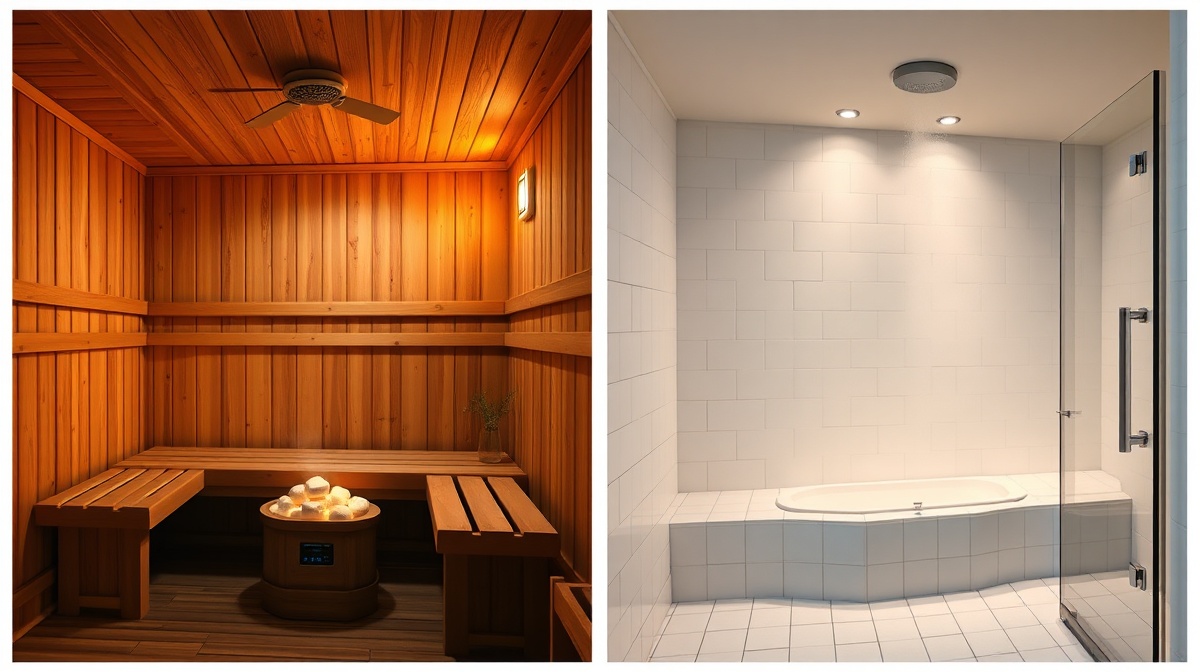
A traditional sauna and a steam room are not interchangeable. Different heat physics. Different construction. Different maintenance burdens. People conflate them because both make you sweat — but the experience, the cost, and the upkeep diverge in ways that matter when you’re deciding which to put in your home. Here’s what the specs, research, and thousands of owner reviews actually say.
How Are a Sauna and Steam Room Actually Different?
The core difference is humidity. A Finnish-style dry sauna operates between 160°F and 195°F (71–90°C) at a relative humidity of 10–20%. A steam room runs cooler — typically 110–120°F (43–49°C) — but at 100% relative humidity. The air is fully saturated. That’s not a small distinction; it changes how your body perceives and sheds heat entirely.
In a dry sauna, sweat evaporates quickly, which is the body’s primary cooling mechanism. In a steam room, evaporation is essentially impossible because the air is already at full moisture capacity. Your body just drips. Same basic stimulus — high heat — but two fundamentally different sensations. That matters when you’re choosing one to build.
Worth naming a third category: infrared saunas. These heat body tissue directly via infrared radiation rather than warming the air, running at lower ambient temperatures (120–140°F). They’re popular in home setups for their lower electrical draw and simpler installation. But they’re a separate discussion from the classic wet/dry comparison.
What Does the Research Say About Health Benefits?
Neither environment is a medical treatment, and neither should be described as one. What research suggests, with appropriate caveats:
Cardiovascular effects are the most studied side of sauna use. A large Finnish cohort study published in JAMA Internal Medicine (Laukkanen et al., 2015) followed 2,315 middle-aged men and found that frequent sauna use — 4–7 sessions per week — was associated with significantly lower risk of fatal cardiovascular events compared with once-weekly use. The study was observational, so causation is not established. Still, it’s the most-cited data point in sauna research for a reason, and the sample size is not trivial.
Muscle recovery is an area where steam rooms are sometimes discussed favorably. Healthline notes that steam rooms may appear more effective at reducing muscle soreness while saunas show stronger cardiovascular associations in the available literature — though neither claim rests on a single definitive randomized controlled trial, and both should be understood as preliminary findings rather than settled science.
Respiratory effects: Warm, humid air is commonly reported to provide temporary relief from congestion and mucous membrane irritation. This is physiologically plausible. It is not a treatment for any respiratory condition.
Skin: Both environments increase skin temperature and promote sweating. Steam rooms are frequently preferred in owner reviews for perceived skin benefits — likely related to the moisture itself — though no controlled trial isolates that perception from placebo.
One firm safety caveat: both environments carry real risks for people with cardiovascular conditions, low blood pressure, pregnancy, or certain medications. Hydration before and after every heat session matters. Anyone with a health condition should consult a clinician before using either regularly. Nothing in this article constitutes medical advice.
Home Installation: What Does Each Actually Cost?
This is usually where the decision gets made.
Dry sauna. A pre-built indoor kit — pre-cut cedar room plus heater — starts around $1,500–$3,000 for a two-person unit before installation labor. Larger or custom-built rooms run $5,000–$15,000+. The electrical requirement is a dedicated 240V circuit, similar to an electric dryer. No special waterproofing beyond the sauna’s own interior lining. Ventilation matters, but it’s manageable.
Steam room. This is where the build gets complicated. A steam room requires a fully waterproofed enclosure — cement board or equivalent substrate under tile, a sloped ceiling to prevent condensation drip, an airtight door, and a steam generator plumbed to a water line. Generator units from manufacturers like Kohler, Mr. Steam, or ThermaSol run $500–$2,500 for hardware alone. Total installed cost including tile, waterproofing, and labor typically lands between $3,000 and $10,000 for a small residential space, according to contractor cost data compiled by Angi.
Ongoing maintenance is where steam rooms lose ground decisively. The 100% humidity environment is relentless on surfaces. Grout, caulk, and door seals need regular inspection and replacement. Mold is a persistent risk if ventilation or drainage is inadequate. Mineral buildup in the steam generator requires periodic descaling — manufacturers generally recommend every 3–6 months in hard-water areas.
Dry saunas are comparatively forgiving. Cedar naturally resists moisture and mold. The heater has few moving parts. Owners consistently describe maintenance as minimal: occasional cleaning, checking the heater elements, and replacing rocks periodically. That’s it.
What About Portable Options?
If a built-in installation isn’t in the budget — or the space simply won’t support one — the portable steam tent category has grown substantially. These are fabric enclosures with a standalone steam generator; your head sticks out the top. They don’t replicate a full steam room. But they deliver genuine moist heat for a fraction of the cost.
One honest trade-off worth flagging upfront: these aren’t the spa experience some buyers picture. Owners consistently note that fabric enclosures feel cramped and that heat retention varies with ambient room temperature. They’re a real option for regular steam sessions — not a substitute for a tile-walled steam room.
Which Is Better for a Home Setup?
There’s no single answer — it depends entirely on what you’re optimizing for.
Choose a dry sauna if you want lower construction complexity, lower maintenance burden, and the most robust body of research (particularly cardiovascular associations) behind the experience. Also the better pick if your space doesn’t have easy access to a plumbed water line.
Choose a steam room if you prioritize moist heat — for respiratory comfort, perceived skin benefits, or simply because you find it more pleasant — and you’re genuinely prepared to invest in proper waterproof construction and ongoing upkeep. A badly built steam room is worse than no steam room. Condensation damage to walls and subfloors is expensive to fix.
Choose a portable steam tent if budget is the deciding factor and you want moist-heat sessions without a construction project. Manage expectations about the experience level; the category is functional, not luxurious.
Recommended Portable Steam Sauna Products
For buyers who want a portable moist-heat option without major construction, these are the strongest picks from currently available Amazon listings.
Durasage Lightweight Personal Steam Sauna
The most-reviewed option in this category at 3,300+ ratings and a 4.3-star average — that volume of feedback is meaningful signal in a market full of fly-by-night tent brands. The 800W steam generator and 60-minute timer are clearly specced. Owners consistently report reliable heat and straightforward setup. The included chair is basic but functional. Best entry-level buy in the category, full stop.
Price as of July 2026: $114.75
Manastin 2 Person Portable Steam Sauna
Newer to market at 579 reviews, but the highest-rated unit in this group at 4.4 stars. Fits two people, includes two foldable chairs, offers 9 heat levels, and ships with a remote. If you want to share sessions, this is the pick. Owners flag that the large footprint needs more floor space than the listing implies — measure before ordering.
Price as of July 2026: $139.49
SereneLife Portable Steam Sauna Tent
The 4L steamer is notably larger than anything else in this roundup, which owners say translates to longer sustained steam without stopping to refill. The 2.9’ × 2.9’ × 5.9’ enclosure is roomier than most single-person tents. At 4.1 stars across 3,000 reviews, it’s proven. The higher price reflects the larger steamer capacity — that’s the trade-off, not some vague premium.
Price as of July 2026: $204.99
X-Vcak Upgraded Portable Sauna (Single)
A solid mid-range option at $141.98 with 9 heat levels and remote control. The 4.1-star average across 1,700 reviews is consistent. Not the cheapest, not the most premium. If the Durasage feels too bare-bones but the SereneLife price is a stretch, this is the logical step up — just know the spec-per-dollar case over the Durasage is thin.
Price as of July 2026: $141.98
Smartmak Sauna Steamer Pot 2.6L
This is a standalone steam generator, not a tent bundle. Buy it if you already own an enclosure or need to replace a failed generator. The 1,000W output — more powerful than some full-tent bundles — combined with remote-controlled time and temperature settings makes it genuinely useful hardware. At $79.41 and 4.2 stars, it’s the best value for a steamer-only purchase. Not a standalone solution for first-time buyers starting from scratch.
Price as of July 2026: $79.41
Frequently asked questions
Is a sauna or steam room better for weight loss?
Neither produces meaningful fat loss on its own. Any weight shed during a session is water weight from sweating, which returns with rehydration. Research on sauna use focuses on cardiovascular associations and recovery effects, not fat metabolism. Claims about saunas or steam rooms 'burning calories like exercise' are not supported by peer-reviewed evidence.
Can I convert a bathroom into a steam room at home?
Technically yes, but it requires full waterproofing — cement board or similar substrate under tile, a sloped ceiling to prevent condensation drip, an airtight door seal, and a steam generator plumbed to a water supply. A standard bathroom is not waterproofed to steam-room standards. Skipping proper construction leads to mold and structural damage. Total installed cost typically runs $3,000–$10,000 depending on size and finishes, according to contractor cost data compiled by Angi.
How long should you stay in a sauna or steam room?
Most health and fitness guidance suggests sessions of 10–20 minutes, with rest and rehydration between rounds. The Finnish sauna tradition often involves multiple rounds with cooling breaks. There is no universal safe limit, and tolerance varies significantly by individual. This is not medical advice — people with cardiovascular conditions, low blood pressure, or who are pregnant should consult a clinician before use.
Do portable steam saunas actually work?
They produce genuine moist heat and cause real sweating — owners consistently confirm that. What they don't replicate is the radiant heat, the wood ambiance, or the sustained high temperatures of a built-in sauna or steam room. They're a functional, budget-friendly option for regular heat sessions, not a like-for-like substitute for a permanent installation.
Which is easier to maintain at home — a sauna or a steam room?
A dry sauna is significantly easier. Cedar naturally resists mold and moisture; maintenance is minimal beyond periodic cleaning and checking the heater. A steam room's 100% humidity environment demands regular inspection of grout, caulk, and door seals, plus periodic descaling of the steam generator — especially in hard-water areas. Neglected steam rooms are prone to mold and structural moisture damage.
Sources
- Association Between Sauna Bathing and Fatal Cardiovascular and All-Cause Mortality Events (Laukkanen et al., JAMA Internal Medicine, 2015) — JAMA Internal Medicine
- Steam Room: Benefits, Risks, and Vs. Sauna — Healthline
- Sauna vs Steam Room: Key Differences in Health Benefits — Sun Valley Saunas
- Sweat it Out: Sauna vs. Steam Room — University at Buffalo Recreation — University at Buffalo
- Steam Room vs. Sauna Comparison Guide — The Spruce
- How Much Does a Steam Room Cost to Build? — Angi — Angi (HomeAdvisor)
- Durasage Lightweight Portable Personal Steam Sauna — Amazon product listing — Amazon
- SereneLife Portable Steam Sauna Tent — Amazon product listing — Amazon
- Manastin 2 Person Portable Steam Sauna — Amazon product listing — Amazon
- X-Vcak Upgraded Portable Sauna — Amazon product listing — Amazon
- Smartmak Sauna Steamer Pot 2.6L — Amazon product listing — Amazon